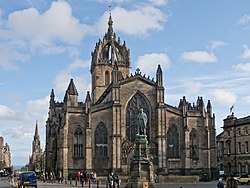
La cathédrale Saint-Gilles (en anglais : Saint Giles' Cathedral) est un édifice construit en 1120 et situé sur le Royal Mile, à Édimbourg, en Écosse. Il est considéré comme l'église-mère du presbytérianisme. L'église n'est pas strictement une cathédrale, car l'Église d'Écosse n'a pas d'évêques. Elle ne fut que brièvement au XVIIe siècle un siège épiscopal du diocèse d'Édimbourg.

1. Histoire

L'église initiale subit un incendie en 1385 et fut reconstruite au cours du XVe siècle. Diverses chapelles furent ajoutées au cours des ans, augmentant ainsi la taille de l'édifice. En 1466, Saint-Gilles devint une église collégiale. La tour-lanterne fut ajoutée vers 1490. Le 7 juillet 1559, à l'apogée de la Réforme écossaise, le conseil d'Édimbourg installa le réformant John Knox comme prêtre de Saint-Gilles. Il y fut enterré en 1572. Il est commémoré par un vitrail au XIXe siècle placé dans le mur sud de l'église et depuis 1904 par une statue de bronze côté nord. C'est dans cet édifice qu'eut lieu, le 23 juillet 1637, une émeute contre le culte anglican que voulait imposer Charles Ier d'Angleterre, d'Écosse et d'Irlande et qui déclencha les guerres des évêques et, au-delà, les guerres des Trois Royaumes.

1. Galerie


1. Notes et références


1. Voir aussi


1. = Articles connexes =

Liste des cathédrales de Grande-Bretagne

1. = Liens externes =

(fr) Fiche sur le site Structurae

Portail de l’architecture chrétienne Portail de l’Écosse Portail du protestantisme Portail des monuments classés au Royaume-Uni

Nearby Places View Menu
Location Image
178 m

Gladstone's Land

Gladstone's Land is a surviving 17th-century tenement house situated in the Old Town of the city of Edinburgh, Scotland. It has been restored and furnished by the National Trust for Scotland, and is operated as a popular tourist attraction.
Location Image
179 m

Lady Stair's House

Lady Stair's House is a 17th-century townhouse in Lady Stair's Close, off the Lawnmarket, in Edinburgh's Old Town. It now houses the Writers' Museum, dedicated to the lives and works of various Scottish literary greats. The house was built in 1622 for Sir William Gray of Pittendrum and his wife Giles (née Smith). A lintel above the door bears the date of construction and the initials WG and GS, along with a coat of arms and the motto "feare the Lord and depart from evill". It was previously known as Lady Gray's House, Giles having resided there for several years after her husband's death. The present name derives from Elizabeth Dalrymple, Dowager Countess of Stair, who acquired the house in 1719. It remained in the possession of the Dalrymple family until 1765, after which it passed through the hands of a succession of owners. In 1895, at the suggestion of the town planner and preservationist Patrick Geddes, it was purchased by Archibald Primrose, 5th Earl of Rosebery, a descendant of the original occupants. Rosebery commissioned the architect George Shaw Aitken to conduct a thorough restoration of the building, and presented it to the city of Edinburgh in 1907. Since then it has been used as a museum, first of civic history and then of literary history. It was designated a Category A listed building in 1970.
Location Image
181 m

Writers' Museum

The Writers’ Museum, housed within Lady Stair's House in Edinburgh, presents the lives of three of the foremost Scottish writers: Robert Burns, Walter Scott and Robert Louis Stevenson. Run by the City of Edinburgh Council, the collection includes portraits, works and personal objects. The museum lies within Makars' Court, which has been described as an "evolving national literary monument".
Location Image
200 m

Lady Stair's Close

Lady Stair's Close (477 Lawnmarket) is a close in Edinburgh, Scotland, just off the Royal Mile, close to the entrance to Gladstone's Land. Most notably it contains the Scottish Writers' Museum.
Location Image
243 m

The Hub, Edinburgh

The Hub is a public arts and events building in the centre of Edinburgh, Scotland. Located at the top of the Royal Mile, it is a prominent landmark as its tall Gothic spire (71.7 meters) is the highest point in central Edinburgh, and towers over the surrounding buildings below Edinburgh Castle. It was the Highland Tolbooth St John's Church. The building is a notable example of Gothic Revival architecture and was designed by architects J Gillespie Graham and Augustus Pugin. Constructed between 1842 and 1845, it was originally designed as a meeting hall for the General Assembly of the Church of Scotland. From 1929 the building was used as a church until the mid-1980s. Today it is the home of the Edinburgh International Festival and is used as a ticket office, information centre and performance venue. The General Assembly of the Church of Scotland continues to meet here each May.