
Location Image

Rothbury Community Hospital

Rothbury Community Hospital in Rothbury, Northumberland, England, is managed by the Northumbria Healthcare NHS Foundation Trust.

1. History


1. = Prior to Joining NHS (1872 - 1948) =

The original facility was built as a private home known as Coquet House in 1872. It was converted into the Coquetdale Cottage Hospital in 1905. A maternity ward was added, as a lasting memorial to soldiers who died in the Second World War, in 1946.

1. = Joinng the NHS and Expansion (1948 - 2007) =

It joined the National Health Service in 1948 and the adjoining Hawthorn Cottage was acquired in 1956. After Hawthorn Cottage had been converted into a physiotherapy department, it was officially reopened by Jimmy Savile in 1990.

1. = New Location (2007 - present) =

After the old hospital became dilapidated, modern facilities were built in Whitton Bank Road and opened in 2007, by local GP, Dr. Angus Armstrong, and his son, TV presenter, Alexander Armstrong. The new hospital closed to inpatients in September 2016 and in June 2019 the trust advised that a group was working on proposals for the future of remaining services at the hospital. The closure caused controversy and a local protest was established called Save Rothbury Cottage Hospital. Rothbury's Member of Parliament, Anne-Marie Trevelyan (Conservative) condemned the closure to inpatients in the House of Commons on 9 March 2017.

1. References


1. External links

Official site

Nearby Places View Menu
Location Image
371 m

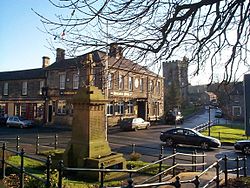
Rothbury

Rothbury is a market town and civil parish in Northumberland, England, on the River Coquet. It is 14 miles (22.5 km) north-west of Morpeth and 26 miles (42 km) north of Newcastle upon Tyne. At the 2011 census, it had a population of 2,107. Rothbury emerged as an important town because of its location at a crossroads over a ford on the River Coquet. Turnpike roads leading to Newcastle, Alnwick, Hexham and Morpeth allowed for an influx of families and the enlargement of the settlement during the Middle Ages. In 1291, Rothbury was chartered as a market town and became a centre for dealing in cattle and wool for the surrounding villages during the Early Modern Era. Later, Rothbury developed extensively in the Victorian era, due in large part to the railway and the industrialist Sir William Armstrong. Between 1862 and 1865, Armstrong built Cragside, a country house and "shooting box" (hunting lodge) just outside Rothbury, and extended it as a "fairy palace" between 1869 and 1900. The house and its estate are now owned by the National Trust and are open to the public, attracting many visitors to the area.
Location Image
691 m

Rothbury railway station

Rothbury was a railway station in Northumberland, England at the end of the single-track Rothbury Branch that served the town of Rothbury. Rothbury was the terminus of the line with a turntable at the end of the track.
1.4 km

Thrum Mill, Rothbury

The Thrum Mill is a grade II-listed water mill in Rothbury, Northumberland, England. The water mill dates back to 1665.
Location Image
2.0 km

Cragside

Cragside is a Tudor Revival country house near the town of Rothbury in Northumberland, England. Dating to the Victorian era, it was the home of William Armstrong, 1st Baron Armstrong, founder of the Armstrong Whitworth armaments firm. An industrial magnate, scientist, philanthropist and inventor of the hydraulic crane and the Armstrong gun, Armstrong also displayed his inventiveness in the domestic sphere, making Cragside the first house in the world to be lit using hydroelectric power. The estate was technologically advanced: the architect of the house, Richard Norman Shaw, wrote that it was equipped with "wonderful hydraulic machines that do all sorts of things". In the grounds, Armstrong built dams and lakes to power a sawmill, a water-powered laundry, early versions of a dishwasher and a dumb waiter, a hydraulic lift and a hydroelectric rotisserie. In 1887, Armstrong was raised to the peerage, the first engineer or scientist to be ennobled, and became Baron Armstrong of Cragside. The original building consisted of a small shooting lodge which Armstrong built between 1862 and 1864. In 1869, he employed the architect Richard Norman Shaw to enlarge the site, and in two phases of work between 1869 and 1882, they transformed the house into a northern Neuschwanstein. The result was described by the architect and writer Harry Stuart Goodhart-Rendel as "one of the most dramatic compositions in all architecture". Armstrong filled the house with a significant art collection; he and his wife were patrons of many 19th-century British artists. Cragside became an integral part of Armstrong's commercial operations: honoured guests under Armstrong's roof, including the Shah of Persia, the King of Siam and two future Prime Ministers of Japan, were also customers for his commercial undertakings. Following Armstrong's death in 1900, his heirs struggled to maintain the house and estate. In 1910, the best of Armstrong's art collection was sold off, and by the 1970s, in an attempt to meet inheritance tax, plans were submitted for large-scale residential development of the estate. In 1971 the National Trust asked the architectural historian Mark Girouard to compile a gazetteer of the most important Victorian houses in Britain which the Trust should seek to save should they ever be sold. Girouard placed Cragside at the top of the list; in 1977, the house was acquired by the Trust with the aid of a grant from the National Land Fund. A Grade I listed building since 1953, Cragside has been open to the public since 1979.