

 English
 Français
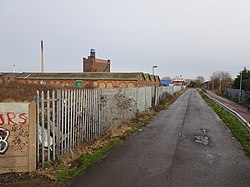
Wilmington railway station served the suburb of Wilmington, Hull, East Riding of Yorkshire, England. It was on the Hull and Hornsea Railway and acted as a temporary terminus of the line. It was replaced in 1912 by a station of the same name west of Wilmington junction on the Victoria Dock Branch Line. The station closed 1964.
Nearby Places View Menu

189 m
Wilmington, Kingston upon Hull
Wilmington is an industrial area east of the River Hull in Kingston upon Hull, England.
445 m
Sculcoates railway station
Sculcoates railway station was a railway station on the North Eastern Railway's Victoria Dock Branch Line in Hull, East Riding of Yorkshire, England. It was first opened by the York and North Midland Railway on 1 June 1853 and closed in November 1854. It was reopened in August 1865, before closing permanently on 9 June 1912.
The station has been demolished but an associated railway goods shed remains in use by a road haulage firm.

606 m
Sculcoates
Sculcoates is a suburb of Kingston upon Hull, north of the city centre, in the East Riding of Yorkshire, England.

1.0 km
Hull Cannon Street railway station
Hull Cannon Street railway station was the passenger terminus in Hull of the Hull, Barnsley and West Riding Junction Railway and Dock Company, which was rebranded in 1905 as the Hull and Barnsley Railway. It opened on 27 July 1885. The station was planned as a goods station only, and the passenger terminus should have been built one-quarter of a mile (0.4 km) south on Charlotte Street. Lack of funds meant that Cannon Street station had to serve both functions. Passenger services were provided in a converted building originally intended as a carriage shed.
Hull Cannon Street station closed to passengers on 14 July 1924, after the London and North Eastern Railway had built the Spring Bank chord to Hull Paragon, and passenger services were diverted there. It closed completely on 3 June 1968. The wooden passenger buildings had disappeared by the late 1970s, the goods office which stood parallel to the street was demolished after 2002. In 2005 Hull College has built motor vehicle workshops for training purposes on the site. Only one set of the iron entrance gates with the original company legend has been reused as the main entrance to the new facilities.