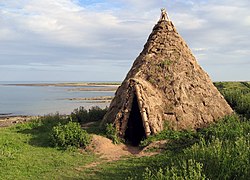
Howick House est un site préhistorique du Mésolithique situé près du village de Howick, dans le Northumberland, en Angleterre. On y a trouvé les traces d'une maison ronde contenant d'importants restes alimentaires.

1. Historique

Le site de Howick House a été découvert lorsqu'un archéologue amateur a remarqué des outils de silex sortant d'une falaise sablonneuse près de village de Howick, dans le Northumberland.

1. Description

Le site archéologique est constitué d'un cercle de trous de poteaux, avec des taches de charbon de bois à leur base, dessinant le contour d'une maison, et d'un certain nombre de trous de pieux, certains orientés vers l'extérieur. On a trouvé à l'intérieur de la maison des foyers peu profonds remplis de charbon de bois, de coques de noix brulées, de quelques fragments d'os, et d'une grande quantité de coquillages marins.

1. Datation

La datation par le carbone 14 des coques de noisette carbonisées a permis d'établir que la maison avait été érigée vers 7600 av. J.-C. et occupée pendant environ 100 ans. Elle a ainsi été qualifiée un temps de « plus vieille maison britannique ». Ce titre a été perdu en 2010 lors de l'annonce de la découverte d'une maison encore plus âgée à Star Carr, dans le Yorkshire du Nord.

1. Analyse

Le volume des restes alimentaires trouvés et la solidité supposée de la construction, déduite du diamètre des trous de poteaux, ont conduit les chercheurs à estimer que cette maison était un lieu de résidence permanente plutôt qu'un lieu de transit saisonnier, et pouvait donc représenter un indice de sédentarisation précoce.

1. Références


1. Voir aussi


1. = Articles connexes =

Maglemosien Star Carr Portail de la Préhistoire Portail de l’Angleterre

Nearby Places View Menu
Location Image
0 m

Howick house

The Howick house is a Mesolithic site located in Northumberland, England. It was found when an amateur archaeologist noticed flint tools eroding out of a sandy cliff face near the village of Howick. Investigations found a circle of substantial post holes with charcoal stains in their bases, a number of smaller stake holes, some angled in from outside a hollow, and inside the house a number of shallow hearths filled with charcoal, burnt nutshells and some fragments of bone. Radiocarbon dating of the charred hazelnut shells established that the building was constructed about 7600 BC and occupied for about 100 years, which led to the find being called "Britain's oldest house". This title was disputed in 2010 when the discovery of the even older 'house-structure' at Star Carr in North Yorkshire was announced. Some of the hearths showed signs only of nut roasting, and the numbers of shells suggested that food was cooked here in quantity, perhaps to preserve it for times of scarcity. Together with the very substantial construction shown by the size of post holes, this led to the view that the house was occupied permanently rather than being used on a transient or seasonal basis as expected during the Mesolithic period. Charred hazelnut shells have been found at several other sites from this period, including Cramond, but their smaller stake holes were interpreted as remains of a temporary encampment. The interpretation that this was a permanent residence for hunter-gatherers is supported by analysis that Howick is a place where natural resources would have allowed all-year-round occupation. Its coastal position provided animals, flint for tools, wood for construction and fuel, fish, seals, sea birds and their eggs, shellfish and a nearby source of fresh water that was available at the time of occupation. Many sites from this time are coastal, but the particular circumstances found here and the evidence of ceremonial ritual from the site at Star Carr in Yorkshire, only 100 miles away, are interpreted as indicating that Mesolithic hunter-gatherers were capable of establishing permanent settlements.
Location Image
336 m

HMS G11

HMS G11 was a G-class submarine of the Royal Navy in service during the First World War. One of six of her class built by Vickers at Barrow in Furness, she was launched on 22 February 1916, and commissioned on 13 May 1916.
Location Image
459 m

Howick, Northumberland

Howick ( HOH-ik) is a village and former civil parish, now in the parish of Longhoughton, in Northumberland, England, between Boulmer and Craster. It is just inland from the North Sea, into which Howick Burn flows from Howick Hall. In 1951, the parish had a population of 246.
Location Image
1.1 km

St Michael and All Angels Church, Howick
St Michael and All Angels Church is a Church of England parish church located within the grounds of the gardens of Howick Hall in the village of Howick, Northumberland, England. The church is recorded in the National Heritage List for England as a designated Grade II listed building, receiving around twenty thousand visitors annually.
Location Image
1.1 km

Howick Hall

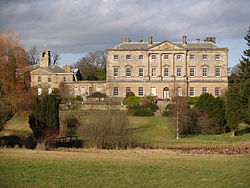
Howick Hall, a Grade II* listed building in the village of Howick, Northumberland, England, is the ancestral seat of the Earls Grey. It was the home of the Prime Minister Charles, 2nd Earl Grey (1764–1845), after whom Earl Grey tea is named. Howick Hall is the location of the Howick Hall Gardens & Arboretum.