
HMS G11 was a G-class submarine of the Royal Navy in service during the First World War. One of six of her class built by Vickers at Barrow in Furness, she was launched on 22 February 1916, and commissioned on 13 May 1916.

1. Description

The G-class submarines were designed by the Admiralty in response to a rumour that the Germans were building double-hulled submarines for overseas duties. The G-class had a length of 187 feet 1 inch (57.0 m) overall, a beam of 22 feet 8 inches (6.9 m) and a mean draft of 13 feet 4 inches (4.1 m). They displaced 703 long tons (714 t) on the surface and 837 long tons (850 t) submerged. The G-class submarines had a crew of 30 officers and ratings. They had a partial double hull. For surface running, the boats were powered by two 800-brake-horsepower (597 kW) Vickers two-stroke diesel engines, each driving one propeller shaft. When submerged each propeller was driven by a 420-horsepower (313 kW) electric motor. They could reach 14.25 knots (26.39 km/h; 16.40 mph) on the surface and 9 knots (17 km/h; 10 mph) underwater. On the surface, the G class had a range of 2,400 nautical miles (4,400 km; 2,800 mi) at 16 knots (30 km/h; 18 mph). The boats were intended to be armed with one 21-inch (53.3 cm) torpedo tube in the bow and two 18-inch (45 cm) torpedo tubes on the beam. This was revised, however, while they were under construction, the 21-inch tube was moved to the stern and two additional 18-inch tubes were added in the bow. They carried two 21-inch and eight 18-inch torpedoes. The G-class submarines were also armed with a single 3-inch (7.6 cm) deck gun.

1. War service

Like the rest of her class, G11's role was to patrol an area of the North Sea in search of German U-boats.

1. Loss

On 22 November 1918, whilst under the temporary command of Lieutenant Commander George Fagan Bradshaw, G11 was returning to her base at Blyth, Northumberland, from Dogger Bank patrol following the Armistice. Sailing through dense fog, she overshot Blyth and ran aground on rocks below cliffs near Howick, some 30 mi (48 km) to the north. The boat's log had been disabled earlier and Bradshaw underestimated her speed in the inclement weather, with the result that the boat had travelled substantially further than he had reckoned. The impact tore the keel off and the boat was abandoned, two of her crew drowning during the evacuation. G11's regular captain Lieutenant Richard Douglas Sandford VC had not sailed on her last mission, having succumbed to typhoid fever. He died at Eston hospital the day after learning his ship had been lost.

1. Citations


1. References

Colledge, J. J.; Warlow, Ben (2006) [1969]. Ships of the Royal Navy: The Complete Record of All Fighting Ships of the Royal Navy from the 15th Century to the Present (Rev. ed.). London: Chatham Publishing. ISBN 978-1-86176-281-8. OCLC 67375475.

Nearby Places View Menu
Location Image
336 m

Howick house

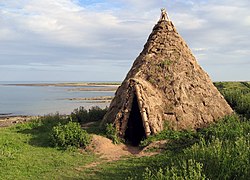
The Howick house is a Mesolithic site located in Northumberland, England. It was found when an amateur archaeologist noticed flint tools eroding out of a sandy cliff face near the village of Howick. Investigations found a circle of substantial post holes with charcoal stains in their bases, a number of smaller stake holes, some angled in from outside a hollow, and inside the house a number of shallow hearths filled with charcoal, burnt nutshells and some fragments of bone. Radiocarbon dating of the charred hazelnut shells established that the building was constructed about 7600 BC and occupied for about 100 years, which led to the find being called "Britain's oldest house". This title was disputed in 2010 when the discovery of the even older 'house-structure' at Star Carr in North Yorkshire was announced. Some of the hearths showed signs only of nut roasting, and the numbers of shells suggested that food was cooked here in quantity, perhaps to preserve it for times of scarcity. Together with the very substantial construction shown by the size of post holes, this led to the view that the house was occupied permanently rather than being used on a transient or seasonal basis as expected during the Mesolithic period. Charred hazelnut shells have been found at several other sites from this period, including Cramond, but their smaller stake holes were interpreted as remains of a temporary encampment. The interpretation that this was a permanent residence for hunter-gatherers is supported by analysis that Howick is a place where natural resources would have allowed all-year-round occupation. Its coastal position provided animals, flint for tools, wood for construction and fuel, fish, seals, sea birds and their eggs, shellfish and a nearby source of fresh water that was available at the time of occupation. Many sites from this time are coastal, but the particular circumstances found here and the evidence of ceremonial ritual from the site at Star Carr in Yorkshire, only 100 miles away, are interpreted as indicating that Mesolithic hunter-gatherers were capable of establishing permanent settlements.
Location Image
578 m

Howick, Northumberland

Howick ( HOH-ik) is a village and former civil parish, now in the parish of Longhoughton, in Northumberland, England, between Boulmer and Craster. It is just inland from the North Sea, into which Howick Burn flows from Howick Hall. In 1951, the parish had a population of 246.
Location Image
1.3 km

St Michael and All Angels Church, Howick
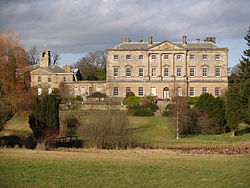
St Michael and All Angels Church is a Church of England parish church located within the grounds of the gardens of Howick Hall in the village of Howick, Northumberland, England. The church is recorded in the National Heritage List for England as a designated Grade II listed building, receiving around twenty thousand visitors annually.
Location Image
1.3 km

Howick Hall

Howick Hall, a Grade II* listed building in the village of Howick, Northumberland, England, is the ancestral seat of the Earls Grey. It was the home of the Prime Minister Charles, 2nd Earl Grey (1764–1845), after whom Earl Grey tea is named. Howick Hall is the location of the Howick Hall Gardens & Arboretum.