

 English
 Français

Capture of Roxburgh (1460)
The capture of Roxburgh was a siege that took place during the Anglo-Scottish Wars. Following the Second War of Scottish Independence intermittent conflict continued along the Anglo-Scottish border with Roxburgh Castle being held by the English since 1346 and by the 1380s was one of the last English held strongholds in Scotland. In July 1460 James II of Scotland began a campaign to reclaim Roxburgh, aiming to take advantage of the fact that the Wars of the Roses were raging in England. During the siege James was mortally wounded when one of his own cannons exploded and the siege was continued by his wife, Mary of Guelders. The castle surrendered on 5 August and was subsequently destroyed by the attackers.
Nearby Places View Menu
24 m
Roxburgh Castle
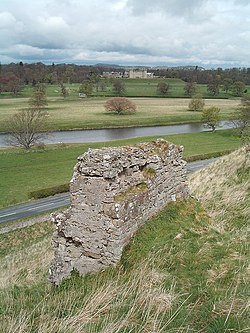
Roxburgh Castle is a ruined royal castle that overlooks the junction of the rivers Tweed and Teviot, in the Borders region of Scotland. The town and castle developed into the royal burgh of Roxburgh, which the Scots destroyed along with the castle after capturing it in 1460. Today the ruins stand in the grounds of Floors Castle, the seat of the Duke of Roxburghe, across the river from Kelso.
27 m
Roxburgh
Roxburgh () is a civil parish and formerly a royal burgh, in the historic county of Roxburghshire in the Scottish Borders, Scotland. It was an important trading burgh in High Medieval to early modern Scotland. In the Middle Ages it had at least as much importance as Edinburgh, Stirling, Perth, or Berwick-upon-Tweed, for a time acting as de facto capital (as royal residence of David I).
71 m
Capture of Roxburgh (1314)
The Capture of Roxburgh was a siege that took place in 1314, which was a major conflict in the First War of Scottish Independence. This siege was a prelude to the Battle of Bannockburn.
952 m
Floors Castle
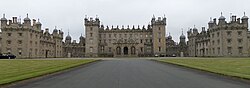
Floors Castle, in Roxburghshire, south-east Scotland, is the seat of the Duke of Roxburghe. Despite its name it is an estate house rather than a fortress. It was built in the 1720s by the architect William Adam for John Ker, 1st Duke of Roxburghe, possibly incorporating an earlier tower house. In the 19th century it was embellished with turrets and battlements, designed by William Playfair, for The 6th Duke of Roxburghe. Floors has the common 18th-century layout of a main block with two symmetrical service wings. Floors Castle stands by the bank of the River Tweed and overlooks the Cheviot Hills to the south.
Floors Castle is now a category A listed building, and the grounds are listed in the Inventory of Gardens and Designed Landscapes, the national listing of significant gardens in Scotland. It is open to the public.