Avellaneda est une commune portuaire argentine, chef-lieu du partido homonyme. La ville se trouve dans la province de Buenos Aires. Sa population est de 328 980 habitants en 2001.

1. Géographie

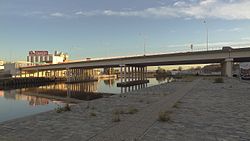
Avellaneda est une banlieue de l'Aire urbaine du Grand Buenos Aires et est reliée à la ville de Buenos Aires par plusieurs ponts qui surplombent le río Matanza. Limitée à l'est par le río Riachuelo, qui rejoint le Río de la Plata, au nord elle s'arrête au Río de la Plata, à l'ouest elle touche le partido de Lanús et au sud le partido de Quilmes.

1. Histoire

À l'origine, la ville s'appelait Barracas al Sur et reçut son nom actuel en 1904, en l'honneur du président de l'Argentine Nicolás Avellaneda. Elle fut ensuite gouvernée, durant plusieurs décennies, par le célèbre caudillo Alberto Barceló (es), membre du Parti démocrate national (conservateur), qui s'illustra par l'élimination physique de ses adversaires et la corruption . Ami du gouverneur fascisant Manuel Fresco, Barceló devait lui succéder mais les élections furent annulées en raison des fraudes massives.

1. Économie

La ville est aussi une concentration de commerces et de centres industriels, essentiels à l'économie du pays, cela concerne les raffineries de pétrole, la métallurgie, les marchés agricoles, le textile …

1. Sport

La ville abrite deux des plus grands clubs de football argentins : CA Independiente et le Racing Club.

1. Personnalités

Alejandra Pizarnik (1936-1972), poétesse, y est née. Adrián Hernán González footballeur argentin, y est né en 1976

1. Notes et références


1. Liens externes

Ressource relative à la musique : MusicBrainz

(es) site officiel de la ville. Coordonnées : 35° 37′ S, 61° 22′ O

Portail de l’Argentine

Nearby Places View Menu
Location Image
119 m

Barracas, Buenos Aires

Barracas is a barrio, or district, in the southeastern part of the city of Buenos Aires, Argentina. It is located between the railroad of Ferrocarril General Manuel Belgrano and the Riachuelo River, and the streets Regimiento de Patricios, Defensa, Caseros, Vélez Sársfield, Amancio Alcorta, Lafayette, and Lavardén. The name "Barracas" comes from the word barraca, which refers to a temporary construction of houses using rudimentary materials.
Location Image
854 m

Bosch Bridge

The Bosch Bridge is a bascule bridge in Buenos Aires, Argentina, that connects the Algarrobo street in Barracas neighborhood with the Barrio Piñeyro of Avellaneda Partido, crossing over Matanza River (popularly known as Riachuelo). The bridge carries vehicular, bicycle, and pedestrian traffic between both points. The bridge extends parallel to the General Roca Railway rail tracks between Hipólito Yrigoyen and Darío Santillán y Maximiliano Kosteki stations. Its structure is made of iron and was inaugurated on July 30, 1908. On July 12, 1930, at 6:05 am, an electric tram going to Lanús fell into the Riachuelo river after the driver ran straight without seeing the red light warning about the leaf raised due to the thick fog. 56 of a total of 60 passengers died, most of them working class people going to their jobs. The tramway accident was mentioned on Sherlock Time, a comic strip by writer Héctor Oesterheld and artist Alberto Breccia published in Hora Cero magazine. In the story, a group of relatives of the victims joined to recreate the accident and then sue the tram company. Nevertheless, Sherlock Time rescued them alive after realising it was a trap from a group of aliens to capture them. In 2001 the Bosch Bridge was closed because of its deterioration. The bridge was then refurbished by the Public Works Ministry of the City of Buenos Aires, which took charge of its maintenance. The bridge was re-opened to the public in June 2008, with height and weight restrictions for the vehicles (4.10 m and 12 tons respectively). Works had a cost of A$ 3,2 million. In September 2015 there was a proposal to adapt the Bosch Bridge for pedestrian use exclusively. The project was named "Puente de las Mariposas" ("Butterflies Bridge"), connecting the Design Metropolitan Center of Barracas with the Faculty of Environmental Sciences of Avellaneda.
Location Image
1.1 km

Pueyrredón Bridge

The Pueyrredón Bridge (officially called Prilidiano Pueyrredón Bridge) is a bascule bridge in Buenos Aires, Argentina. It connects Vieytes street of Barracas neighborhood with Bartolomé Mitre Avenue in Avellaneda Partido, crossing over Matanza River (popularly known as Riachuelo). The bridge carries vehicular, bicycle, and pedestrian traffic between both points. It was named after painter and architect Prilidiano Pueyrredón, one of the country's first prominent artists.
Location Image
1.1 km

New Pueyrredón Bridge

The New Pueyrredón Bridge, officially New Prilidiano Pueyrredón Bridge, is a bridge in Buenos Aires, Argentina, that connects President Arturo Frondizi Highway (AU9, formerly 9 de Julio Sur Highway) in Barracas neighborhood with Bartolomé Mitre and Hipólito Yrigoyen avenues, both in Avellaneda Partido. The bridge crosses over Matanza River (popularly known as Riachuelo), carrying vehicular and pedestrian traffic between both points. The structure is made of reinforced concrete.
Location Image
1.2 km

Buenos Aires Belgrano Sur Line railway station

Buenos Aires (Spanish: Estación Buenos Aires) is a former passenger railway station in the city of Buenos Aires, Argentina. The station was terminus of the Belgrano Sur line that runs trains along Greater Buenos Aires region. The station is located a short distance north of the Riachuelo River, on the boundaries between the barrios of Parque Patricios and Barracas, two outlying neighbourhoods in the southern part of the city.