

 English
 Français
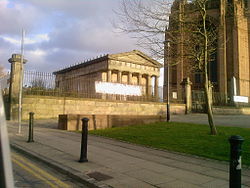
The Oratory stands to the north of Liverpool Anglican Cathedral in Merseyside, England. It was originally the mortuary chapel to St James Cemetery, and houses a collection of 19th-century sculpture and important funeral monuments as part of the Walker Art Gallery. It is a Grade I listed building in the National Heritage List for England.
Nearby Places View Menu
103 m
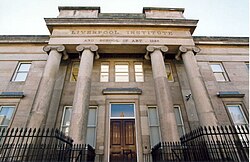
Liverpool Institute High School for Boys
The Liverpool Institute High School for Boys was an all-boys grammar school in the English port city of Liverpool.
The school had its origins in 1825 but occupied different premises while the money was found to build a dedicated building on Mount Street. The institute was first known as the Liverpool Mechanics' School of Arts. In 1832 the name was shortened to the Liverpool Mechanics' Institution. The façade of the listed building, the entrance hall and modified school hall remain after substantial internal reconstruction was completed in the early 1990s.
103 m
Liverpool Institute for Performing Arts
The Liverpool Institute for Performing Arts (LIPA) is a performing arts higher education institution in Liverpool, founded by Paul McCartney and Mark Featherstone-Witty and opened in 1996. It is a member of the Federation of Drama Schools.
The Education Guardian has previously ranked LIPA No. 1 in the UK for several of its degree courses, and it is regularly ranked as one of the top 10 specialist institutions.
In September 2003, LIPA launched LIPA 4–19, a part-time performing arts academy for 4-to-19-year-olds. LIPA started its own primary free school in 2014 and its own sixth form free college in 2016.

122 m
The Hardmans' House
The Hardmans' House, at 59 Rodney Street, Liverpool, Merseyside, England, is a National Trust property and home of the "E. Chambré Hardman Studio, House & Photographic Collection". The property was acquired by the National Trust in 2003.
The house is a Georgian terraced house which served as both the studio and home of photographer E. Chambré Hardman from 1947 to 1988, and his wife, business partner and fellow photographer, Margaret until her death in 1969. On display are an extensive collection of photographs, the studio where most were taken, as well as the darkroom where they were developed and printed.
The collection consists of portraits of the people of Liverpool, their city and the landscapes of the surrounding countryside.

137 m
Liverpool College of Art
Liverpool College of Art has an unbroken history dating back to 1825, making it the oldest English school of art outside London. From 1883 it was located at 68 Hope Street, Liverpool, England, in a building designed by Thomas Cook, which is now Grade II listed. Cook's design was the winner from a competition which attracted 96 entries. The cost was £12,000, which was mostly provided by one of the school's Board of Directors. An extension, by architects Willink & Thicknesse, who also designed the Cunard Building, was added in 1910. William Willink stepped down from his role as Director of Technical Instruction at the school to carry out the commission. The extension abutted 68 Hope Street and fronted the school's preexisting premises on Mount Street (later the Liverpool Institute High School for Boys, and subsequently, LIPA, the Liverpool Institute for Performing Arts). The cost was £19,852.
What had previously been known as Liverpool School of Art was granted the title of Regional College of Art for Liverpool by the Ministry of Education in 1949. In 1970 Liverpool College of Art became part of the newly-formed Liverpool Polytechnic, which achieved university status as Liverpool John Moores University in 1992. The university's School of Art and Design moved to new premises at the Art and Design Academy in 2008.
Amongst its former students are John Lennon, Cynthia Lennon, Maurice Cockrill, Ray Walker, Stuart Sutcliffe, Margaret Chapman, Ruth Duckworth, Phillida Nicholson and Bill Harry. Sir James Stirling studied there while working at an architect's office after leaving school.
In 1975, Clive Langer, Steve Allen, Tim Whittaker, Sam Davis, Steve Lindsey, John Wood and Roy Holt (a mix of Fine Art students and tutors at the college) founded seminal 'art rock' band Deaf School and went on to sign a record deal with Warner Bros Records US after being 'discovered' by former Beatles publicist and head of Warner Bros UK at the time Derek Taylor. Deaf School are acknowledged as catalysts of the post-Beatles musical revival in the city.
Staff at the Liverpool College of Art in the late 1950s (at the time of John Lennon and Stuart Sutcliffe) included Walter Norman, Julia Carter Preston, Arthur Ballard, Charles Burton, Nicholas Horsfield, George Mayer-Marton, E. S. S. English, Alfred K. Wiffen, Austin Davies, Philip Hartas, and the college's then-principal W. L. Stevenson.
June Furlong was a life model at the school for 48 years, from 1947 to 1995, having also modelled at the Slade School of Fine Art, Goldsmiths College and the Royal College of Art and for Augustus John, Lucian Freud, Frank Auerbach.
In March 2012, the adjoining Liverpool Institute for Performing Arts (LIPA) announced that it had purchased the former Liverpool College of Art building for £3.7million to expand its teaching space.