
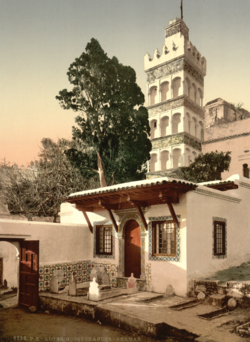
The Madrasa Thaalibia (Arabic: المدرسة الثعالبية; French: Médersa Thaâlibiyya), is a madrasa located in Algiers, Algeria. It was founded on 17 October 1904 by Charles Jonnart and subsequently became one of the leading spiritual and educational centres of Algeria.

1. Architecture

The building of this madrasa was designed by the architect Henri Petit (1856–1926). The style followed the Moorish Revival architecture under the guidance of Jonnart, Four domes flank the central dome, a vestibule and a porch open between the two domes of the main façade. All the walls are lined, halfway up, with paneled earthenware faience and tiles. For about fifty years since 1954, the building no longer has its vocation as a higher establishment for Medersians.

1. Teachers

Abdelhalim Bensmaia Mohamed Bencheneb Abdelkader Medjaoui Ali Ammali Belkacem Hafnaoui Abderrazak Ashraf Mohamed Saïd Ben Zekri

1. Students

Omar Racim Si Kaddour Benghabrit Abderrahmane Djilali Noureddine Abdelkader

1. See also

Charles Jonnart

1. References


1. External links
Nearby Places View Menu
Location Image
50 m

Thaalibia Cemetery

Thaalibia Cemetery (Arabic: المقبرة الثعالبية) or Abd al-Rahman al-Tha'alibi Cemetery (Arabic: مقبرة سيدي عبد الرحمان الثعالبي) is a cemetery in the Casbah of Algiers in the commune of the Casbah of Algiers. The name "Thaalibia" is related to Abd al-Rahman al-Tha'alibi.
Location Image
50 m

Zawiya Thaalibia (Algiers)

The Zawiya Thaalibia (Arabic: الزاوية الثعالبية) or the Sidi Abd al-Rahman al-Tha'alibi Zawiya (Arabic: زاوية سيدي عبد الرحمان الثعالبي) is a zawiya in the Casbah of Algiers in the commune of Casbah in Algeria. The name "Thaalibia" relates to Abd al-Rahman al-Tha'alibi.
Location Image
142 m

Casbah of Algiers

The Casbah of Algiers, commonly referred to as the Casbah (Arabic: القصبة, Al-qaṣabah, meaning "citadel"), corresponds to the old town or medina of Algiers, the capital of Algeria. It is a historic district that has been listed as a UNESCO World Heritage Site since 1992. Administratively, it is located within the municipality of Casbah, in the province of Algiers. Likely inhabited since the Neolithic period, as were various sites in the Algiers Sahel, the first mentions of the city date back to Antiquity, when it was initially a Phoenician port, later becoming Berber and eventually Roman. The current urban framework was designed in the 10th century by the Berbers under the Zirid dynasty, later enriched by contributions from other Berber dynasties that successively ruled the central Maghreb. The Casbah reached its peak during the period of the Regency of Algiers, serving as the seat of political power. Colonized by the French in 1830, it was gradually marginalized as power centers shifted to the new city. During the Algerian War, the Casbah played a crucial role, as a stronghold for FLN independence fighters. After Algeria gained independence in 1962, the Casbah did not reclaim its former central role and remained a marginalized city area. An example of Islamic architecture and urban planning characteristic of Arab-Berber medinas, the Casbah is also a symbol of Algerian culture, a source of artistic inspiration, and home to an ancestral artisanal heritage. Local actors continue to fight to preserve and sustain its tangible and intangible heritage.
Location Image
143 m

Zaouïa of Sidi Saâdi

The Zaouïa of Sidi Saâdi (also rendered Zawiya of Sidi Saâdi) is a religious building and educational institution located in Algiers, Algeria. It is one of the Zawiyas in Algeria affiliated with the Rahmaniya Sufi order under the supervision of the Ministry of Religious Affairs and Wakfs, in accordance with the Algerian Islamic reference. The full name of its founder Sidi Saâdi, the learned faqīh, is Abou Abdallah Mohamed ben Mohamed Saâdi.