

 English
 Français

Cridling Stubbs
Cridling Stubbs est un village et une paroisse civile du Yorkshire du Nord, en Angleterre.
Nearby Places View Menu
0 m
Cridling Stubbs
Cridling Stubbs is a village and civil parish in North Yorkshire. It is near the town of Knottingley. In 2011 it had a population of 152.
The village was historically part of the West Riding of Yorkshire until 1974. From 1974 to 2023 it was part of the district of Selby, it is now administered by the unitary North Yorkshire Council.
A Romano-British hoard of 3,330 coins in a jar (the Cridling Stubbs Hoard) dating to the 4th century AD was found near the village in 1967.

1.9 km
Stapleton Colony
The Stapleton Colony, based in Stapleton, North Yorkshire, is a Christian pacifist and anarchist community, and the only remaining colony of the Brotherhood Church. By 2016 the population of the colony had declined to four residents.
In 1897 several members of the Brotherhood Church, some from a Quaker background, moved to Leeds. The receipt of a legacy left to a member, Lillian Ferris, enabled the group to relocate to a seven and a half acre smallholding at Stapleton in 1921.
The Stapleton community are vegetarian, grow much of their own organic food and attempt to live independently from the government. They are affiliated to the Peace Pledge Union, Campaign for Nuclear Disarmament and War Resisters' International. Residents have included Len W. Gibson (1919–2007) who was a lifelong peace campaigner and conscientious objector.
1.9 km
Stapleton, Selby
Stapleton is a village and civil parish in North Yorkshire, England. In 2001 the parish had a population of 59. The population taken at the 2011 Census was less than 100. Details are included in the civil parish of Womersley. It is situated approximately 3 miles (5 km) south-east from the towns of Pontefract and Knottingley.
From 1974 to 2023 it was part of the district of Selby, it is now administered by the unitary North Yorkshire Council.
The name Stapleton derives from the Old English stapoltūn meaning 'post settlement'.
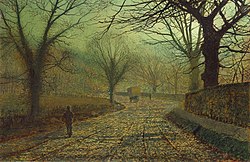
Stapleton Park was the subject of a well-known painting of the Victorian era by John Atkinson Grimshaw.
Stapleton is home to the Stapleton Colony of the Brotherhood Church.
2.1 km
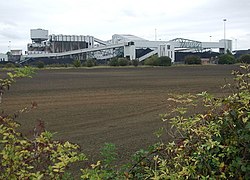
Kellingley Colliery
Kellingley Colliery, known affectionately as the 'Big K', was a deep coal mine in North Yorkshire, England, 3.6 miles (5.8 km) east of Ferrybridge power station. It was owned and operated by UK Coal.
The colliery closed on 18 December 2015, marking the end of deep-pit coal mining in Britain. The site is earmarked for commercial development.

2.2 km
Mary Towneley Loop
The Mary Towneley Loop is a 47-mile (76 km) circular route that forms part of the Pennine Bridleway National Trail, along the borders of Lancashire and Yorkshire. The loop was opened in 2002, the first section of the Pennine Bridleway.
It is named in memory of Mary, Lady Towneley, who drew attention to the poor state of England's bridleways and the need for a long-distance route for horse-riders by riding with two friends in September 1986 from Hexham in Northumberland to Ashbourne in Derbyshire. She died in 2001.
The route joins the main Pennine Bridleway at two points, one near the village of Summit between Littleborough and Todmorden, and one just east of Worsthorne. Heading west from Summit the Loop climbs to Top of Leach at 474 metres (1,555 ft). The trail then passes through the town of Waterfoot in the Rossendale Valley and follows new tracks via Lumb before entering the Cliviger Gorge and then climbing up to the Long Causeway. It then heads north to rejoin the main Pennine Bridleway just east of Worsthorne. The Loop then follows the main route to enter West Yorkshire at Widdop, crosses Heptonstall Moor and drops down to cross the Calder Valley just west of the town of Hebden Bridge. The trail passes the villages of Mankinholes and Bottomley to return to Summit.
An annual relay race, organized by Rossendale Harriers, took place in late January or early February until 2011. Teams consisting of five pairs of runners race over five relay legs completed the entire 47 miles and 6,400 feet of ascent of the loop, clockwise from Fearns Sports College in Stacksteads. The last race in 2011 took place on 30 January and hosted 109 teams, 1,090 individual runners from clubs across the north of England, and was won by Salford Harriers.