
Battery Park City est un quartier situé à l'extrémité sud-ouest de l'île de Manhattan à New York. Il a été bâti sur le modèle d'une ville nouvelle, sur une superficie de 0,37 km2. Le terrain sur lequel il repose a été gagné sur l'Hudson, en utilisant 917 000 mètres cubes de terre et de roche extraites lors de la construction du World Trade Center et d'autres projets immobiliers. Ce quartier abrite le World Financial Center, ainsi que nombre de logements et de commerces. Son nom provient du parc voisin, le Battery Park. Battery Park City est la propriété de la Battery Park City Authority, une entreprise publique créée en 1968 par l'État de New York et qui n'est pas contrôlée par la municipalité de New York. Les revenus excédentaires de cette entité servent à subventionner d'autres investissements pour le logement, en particulier dans les zones plus défavorisées du Bronx et de Harlem.

1. Géographie

À l'est, Battery Park City est séparée du Financial District par West Street. Dans les autres directions, la zone est entourée par l'estuaire du fleuve Hudson. Le quartier est divisé en cinq principales sections (du nord vers le sud) :

Un parc, le N A Rockefeller Park, bordé par quelques immeubles résidentiels et un grand hôtel. La zone du World Financial Center, qui comporte quatre immeubles de bureaux (dont celui d'American Express), une serre (Winter Garden) et un port de yachts. Gateway Plaza Rector Place Battery Place Les trois dernières sont des zones résidentielles comprenant supermarchés, restaurants et salles de cinéma.

1. Histoire

À la fin des années 1950, cette partie inférieure du port de Manhattan tombait en décrépitude, victime de l'essor du transport aérien. Une première proposition pour remblayer le fleuve Hudson fut émise au début des années 1960 par des sociétés privées ayant le soutien du maire. Les choses se compliquèrent quand le gouverneur Nelson Rockefeller annonça qu'il souhaitait redévelopper cette zone indépendamment de la municipalité. Un compromis fut trouvé en 1966, avec la présentation d'un concept de « communauté étendue » par l'architecte Wallace K. Harrisson, qui intégrait logement, infrastructures sociales et industries légères. En 1968, la Battery Park City Authority (BPCA) fut créée pour en superviser le développement. Pendant les premières années les progrès furent minces : en 1969, un plan fut élaboré et en 1972, 200 millions de dollars d'actions furent émises pour financer la construction. En 1976, le remblaiement du fleuve était terminé, la plupart des anciens quais abandonnés ayant été simplement enfouis sous des tonnes de terre. Des difficultés financières interrompirent l'effort de construction entre 1977 et 1979, quand la propriété du terrain fut transféré de la municipalité vers le BPCA et que le projet fut révisé à la baisse. Les premiers immeubles apparurent en 1980, suivi en 1981 par la construction du World Financial Center, inauguré en 1985 et achevé en 1987. Pendant toutes les années 1980, les travaux allèrent bon train, Rector Place fut terminée ainsi que l'esplanade longeant la rivière. La Stuyvesant High School déménagea dans le quartier au début des années 1990. À la fin du XXe siècle, Battery Park City était pratiquement construite. L'attaque terroriste du 11 septembre 2001 sur le World Trade Center voisin eut un impact considérable sur le quartier. Plus des deux-tiers des habitants fuirent la zone proche de la catastrophe. Gateway Plaza, le plus imposant des immeubles résidentiels, reçut des débris provenant des avions, et le Winter Garden fut sérieusement endommagé. Les résidents craignaient également la poussière omniprésente après la catastrophe. Depuis, la plupart des réparations ont été effectuées, le prix des loyers a baissé et le gouvernement a encouragé par des subventions la remise en état et la réoccupation des lieux.

1. Notes et références


1. Voir aussi


1. = Articles connexes =

Teardrop Park

1. = Liens externes =

Battery Park City Authority Photos de Battery Park City

Portail de New York

Nearby Places View Menu
Location Image
237 m

200 Liberty Street

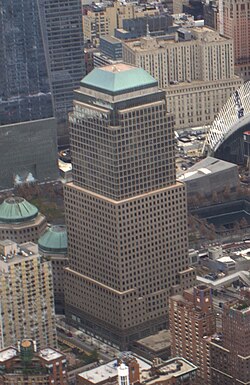
200 Liberty Street, formerly known as One World Financial Center, is one of four towers that comprise the Brookfield Place complex in the Battery Park City, directly adjacent to the Financial District of Lower Manhattan in New York City. Rising 40 floors and 577 feet (176 m), it is situated between the Hudson River and the World Trade Center. The building is on Liberty Street between South End Avenue and West Street. The building opened in 1986 as part of the World Financial Center and was designed by Cesar Pelli & Associates. It has a leasable area of 1,628,000 square feet (151,200 m2). Similarly to other WFC buildings it has a unique roof which is designed to resemble a Mastaba, which is a truncated square pyramid, and follows the theme of using ancient structures as the roofs for the rest of the WFC (the other tops are a dome, a pyramid and a stepped pyramid). It is connected to the rest of the complex by a skybridge over Liberty Street. The building is located across the street from the World Trade Center site and was significantly damaged in the September 11 attacks. The initial dust cloud and other explosions shattered many windows, heavily damaging nearby Winter Garden Atrium and other buildings of the World Financial Center complex. It was closed for several months and reopened in 2002 after extensive restoration. It was renamed 200 Liberty Street when the rest of the complex became Brookfield Place in 2014.
Location Image
280 m

The Sphere

The Sphere (officially Große Kugelkaryatide N.Y., also known as Sphere at Plaza Fountain, WTC Sphere or Koenig Sphere) is a monumental cast bronze sculpture by German artist Fritz Koenig. The world's largest bronze sculpture of modern times stood between the Twin Towers on the Austin J. Tobin Plaza of the World Trade Center in New York City from 1972 until the September 11 attacks. The work, weighing more than 20 tons, was the only remaining work of art to be recovered largely intact from the ruins of the collapsed Twin Towers. After being dismantled and stored near a hangar at John F. Kennedy International Airport, the sculpture was the subject of the 2001 documentary Koenig's Sphere. Since then, the bronze sphere has become a memorial for the attacks. The sculpture was installed in Battery Park between 2002 and 2017, when the Port Authority of New York and New Jersey moved it to Liberty Park, overlooking the September 11 Memorial and its original location. The sculpture, rededicated at its permanent location on August 16, 2017, has been kept in the badly damaged condition it was found in after the September 11 attacks.
Location Image
286 m

America's Response Monument

America's Response Monument, subtitled De Oppresso Liber, is a life-and-a-half scale bronze statue in Liberty Park overlooking the National September 11 Memorial & Museum in New York City. Unofficially known as the Horse Soldier Statue, it is the first publicly accessible monument dedicated to the United States Army Special Forces. It was also the first monument near Ground Zero to recognize heroes of the September 11 terrorist attacks. The statue was conceived by sculptor Douwe Blumberg and first sold in 2003 as a small-scale, 18 inches (460 mm) version. In April 2011, an anonymous group of Wall Street bankers who lost friends in the 9/11 attacks commissioned a large, 16 feet (4.9 m) tall version. It was dedicated on Veterans Day, November 11, 2011, in a ceremony led by Vice President Joe Biden and Lt. Gen. John Mulholland, commander of Task Force Dagger and U.S. Army Special Operations Command during Operation Enduring Freedom. The statue commemorates the service members of America's Special Operations forces and their response to 9/11, including those who fought during the first stages of the Afghanistan war. This operation led to the initial defeat of the Taliban in Afghanistan, although the Taliban would ultimately regain power following their 20-year-long war with the United States.
Location Image
292 m

Liberty Park

Liberty Park is a one-acre (0.40 ha) elevated public park at the World Trade Center in Manhattan, New York City, overlooking the National September 11 Memorial & Museum in Lower Manhattan. The park, which opened on June 29, 2016, is located above the World Trade Center's Vehicular Security Center. The St. Nicholas National Shrine is located within the park, as well as Fritz Koenig's The Sphere, the iconic sculpture salvaged from the World Trade Center site. Another statue, America's Response Monument, is also located in the park.
Location Image
307 m

St. Nicholas Greek Orthodox Church (Manhattan)

The St. Nicholas Greek Orthodox Church, officially the St. Nicholas Greek Orthodox Church and National Shrine, is a church and shrine in the World Trade Center in Lower Manhattan, New York City. It is administered by the Greek Orthodox Archdiocese of America and has been developed by the Port Authority of New York and New Jersey, based upon a design by Spanish architect Santiago Calatrava. The church was consecrated on July 4, 2022. St. Nicholas replaced the original church of the same name that was destroyed during the September 11 attacks in 2001—the only house of worship, and only building outside the original World Trade Center complex, to be completely destroyed. The new church is located in Liberty Park, overlooking the National September 11 Memorial & Museum. Its architecture draws from Byzantine influences, namely the Church of the Savior and the Hagia Sophia in Istanbul, as well as from the Parthenon in Athens. In addition to serving as a Greek Orthodox parish, St. Nicholas acts as a "House of Prayer for all people" that functions as a national shrine and community center, incorporating a secular bereavement space, social hall, and various educational and interfaith programs. Initially scheduled to open in 2016, St. Nicholas' rebuilding effort was beset by delays, cost overruns, and claims of financial impropriety. In 2019, the nonprofit Friends of St. Nicholas was founded to help complete the project, which continued under the auspices of the newly elected Archbishop Elpidophoros. The church was partially opened for a memorial service commemorating the 20th anniversary of the September 11 attacks. The church fully opened on December 6, 2022, the Feast of Saint Nicholas.