Inkerman, Renfrewshire

Inkerman was a small hamlet set up in 1858 in the Abbey Parish of Paisley to house ironstone miners. Later employment came from ancillary operations, including shale coal and oilworks. Inkerman has a total of seven pits. The hamlet was named after a recent (1854) British military victory, the Battle of Inkerman, in the Crimean War. Similarly, the nearby Balaklava settlement housed miners for the Clippens mines (now in Linwood) from 1855. The hamlet of Redan was named to commemorate the storming of the fortifications - Redan - in the Siege of Sevastopol (1854–1855). The miners from these settlements had their own rivalries. On Saturday 12 July 1859 the miners from The Redan in Linwood, on one side of the Black Cart Water, and their rivals from Inkerman, on the other side, met in the (grandly called) Battle of Linwood Bridge. (The bridge is still there at the end of Bridge Street, Linwood). The men were armed with various weapons such as mining tools, swords and cudgels. A bloody battle was fought resulting in the death of one man and several others were badly injured Inkerman was near Candrens, where Blackstone Road passes under the A737. It consisted of three rows of cottages (built by the mine owners Merry & Cunninghame Ltd) called Row One, Row Two and Row Three, plus a shop, a school and a schoolhouse. The school and schoolhouse still exist, the latter as a private house. A reading room was attached to the school. A Church of Scotland Mission Hall was erected and later the Inkerman Bowling Club (which still exists, on the Blackstoun Road) was formed. As the population increased, Oilwork Row and Store Row were added to the so-called "miners' raws" (sic). The Store was company-run, and much credit was extended to miners, often against the law (the Truck Acts). The Store was also the Post Office. The population of the hamlet grew from 723 (1871), to 948 (1881). As the mines became exhausted the population began to decline - for example to 699 (1891). There was an oilwork, (The Walkinshaw Oil Company) extracting oil from the shale, and a brickwork (part of Merry and Cunninghame's operation) was established to make bricks from the shale waste, - the blaes - but this disappeared with the mining industry. People drifted away and the last of the "miners’ raws" was demolished in the 1940s. Inkerman is no longer listed on maps but can be found on the historic Ordnance Survey series, as can Balaklava near Clippens.

Lieux à Proximité Voir Menu
Location Image
1.1 km

St Mirren Park

Le St Mirren Park est un stade de football situé à Paisley. Il accueille depuis 2009 les matches à domicile du St Mirren Football Club, club évoluant en première division écossaise. Auparavant les rencontres se jouaient à Love Street. Ce stade a une capacité de 8 023 places.
Location Image
2.0 km

Love Street (stade)

St Mirren Park, plus connu sous le nom de Love Street, était un stade de football situé sur Love Street à Paisley, en Écosse . À une certaine époque, le stade pouvait accueillir près de 50 000 spectateurs, mais dans ses dernières années, il avait une capacité de 10 800 places assises. Jusqu'à sa fermeture en 2009, c'était le stade du St Mirren FC . Le terrain de football de Love Street a été enregistré comme Fullerton Park pour la première saison de St Mirren, car il était à l'origine loué à un M. Fullerton. La fréquentation record du terrain était de 47 438 spectateurs pour un match contre le Celtic en 1949. St Mirren a achevé la construction de son nouveau St Mirren Park en décembre 2008. Le club a disputé son dernier match à Love Street, contre Motherwell, le 3 janvier 2009.
Location Image
2.1 km

Attentat de l'aéroport international de Glasgow

L'attentat de l'aéroport international de Glasgow a eu lieu le 30 juin 2007 à 15 h 11 heure locale (UTC+1). Une voiture piégée, une Jeep Cherokee chargée de gaz et de pétrole a percuté la porte principale en verre du terminal 1 de l'aéroport international de Glasgow en Écosse, blessant grièvement un des deux passagers du véhicule et plus légèrement un passant. Les deux passagers ont immédiatement été arrêtés par la police alors que le passager blessé arrosait l'entrée du terminal d'essence.
Location Image
2.1 km

Observatoire Coats

L’Observatoire Coats (Coats Observatory) est l'un des quatre observatoires astronomiques publics du Royaume-Uni. Il est situé à Paisley, en Écosse, et a été conçu par l'architecte John Honeyman sur un financement local en provenance du propriétaire de filatures Thomas Coats. La conception a intégré de nombreuses caractéristiques de l'architecture victorienne. Le bâtiment fut ouvert le 1er octobre 1883. Le télescope utilisé date de 1889. En 1901, du matériel d'enregistrement sismique fut intégré dans un pavillon. Il fut démoli vers 1930 mais l'observatoire continue à fonctionner comme une station de surveillance sismique du British Geological Survey.
Location Image
2.6 km

Aéroport international de Glasgow

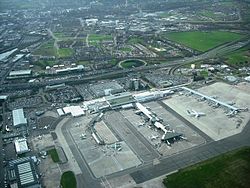
L'Aéroport de Glasgow (aussi connu sous le nom de l'Aéroport International de Glasgow, (code IATA : GLA • code OACI : EGPF), est un aéroport international en Écosse, situé à 11 km du centre-ville de Glasgow. En 2014, l'aéroport a accueilli environ 7,7 millions de passagers, une augmentation de 4,8 % par rapport à 2013, faisait cet aéroport le second en Écosse, après celui d'Édimbourg, et le huitième au Royaume-Uni. C'est le principal aéroport pour entrer en Écosse pour les vols transatlantiques et direct long-courrier. L'aéroport est dirigé et exploité par AGS Airports, qui exploite aussi les aéroports d'Aberdeen et de Southampton. Précédemment, il était dirigé et exploité par Heathrow Airport Holdings (aussi connu comme BAA). Les principaux locataires de l'aéroport sont British Airways et Loganair (actuellement utilisé par Flybe), l'utilise comme un hub. D'autres compagnies aériennes majeures utilisant cet aéroport comme une base sont Flybe, EasyJet, Jet2, Thomas Cook Airlines et Thomson Airways. L'aéroport de Glasgow ouvre ses portes en 1966 et avant les vols étaient exploités uniquement au Royaume-Uni et en Europe. Le British Airports Authority (BAA) prend le contrôle the l'aéroport en 1975 et quand BAA a privatisé dans les années 1980, l'aéroport de Glasgow commença à offrir d'autres vols autour du monde, ces vols étaient utilisés à l'aéroport de Glasgow Prestwick, qui a ensuite été relégué comme le secondaire aéroport de restauration pour les compagnies aériennes low cost , de fret et exploitants de vols charters.