Williams-Whittlesey Motor Boat and Shipbuilding Co., often referred to as Williams-Whittlesey Co. and known until 1904 as the Standard Boat Co., was an American boatbuilding company in Queens, New York, that operated at least from 1891 to 1910. Headquartered in Long Island City with a boatyard in the adjacent Astoria neighborhood, the company produced tugboats, river vessels, scows, and yachts. Among its products were two private motorboats that were later commissioned by the United States Navy for service during World War I: Osprey II, which served as USS Osprey II (SP-928) from 1917 to 1918; and Althea, which served as USS Althea (SP-218) from 1917 to 1919. In 1904, the Standard Boat Co.'s owners changed the name to Williams-Whittlesey Motor Boat and Shipbuilding Co. because they "felt that their firm was very often confused with the Standard Motor Construction Co. of Jersey City, New Jersey". Among its naval architects was H. Newton Whittelsey, whose yacht designs were noted for introducing "the modern type of large raised deck cruiser," according to Motor Boating magazine. Another employee was Daniel I. Whittlesey, a 1901 graduate of Yale University's Sheffield Scientific School. By 1916, Whittelsey and Whittlesey had formed their own shipbuilding company headquartered at 11 Broadway in Manhattan.

1. External links

"Talks With Our Naval Architects: H. Newton Whittelsey," Transcribed from p. 16 of the June 1910 issue of Motor Boating magazine, a magazine about motorboats that published from 1907 to 2011, ending its run as MotorBoating. 1917 article describing proposals by the Whittelsey & Whittlesey Co.

1. References
Lieux à Proximité Voir Menu
Location Image
33 m

Bowling Green (New York)

Le Bowling Green est un petit jardin public du quartier de Lower Manhattan à New York, situé au pied de Broadway, près du site du quartier hollandais de La Nouvelle-Amsterdam. Construit en 1733, son nom vient du fait qu'il comportait à l'origine un boulingrin (bowling green). En forme de goutte d'eau, il est le parc public le plus ancien de New York, et il est encore à ce jour entouré par une barrière datant du XVIIIe siècle. Au nord du jardin se trouve la sculpture du taureau de Wall Street (Charging Bull). Le Bowling Green Fence and Park fait partie du Registre national des lieux historiques.
Location Image
63 m

Taureau de Wall Street

Le Taureau de Wall Street (en anglais Charging Bull, Wall Street Bull ou Bowling Green Bull) est une sculpture en bronze de l'artiste italien Arturo Di Modica située au Bowling Green Park, près de la bourse de New York (Wall Street) aux États-Unis.
Location Image
81 m

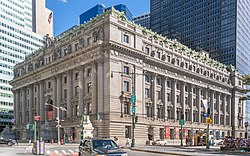
Alexander Hamilton U.S. Custom House

La Alexander Hamilton U.S. Custom House est une maison de douane (Custom House) érigée en 1902–1907 par le gouvernement fédéral pour abriter les opérations de perception des droits pour le port de New York. Conçu par Cass Gilbert dans le style Beaux-Arts, il se trouve au 1 Bowling Green dans le Financial District près de la pointe sud de Manhattan à New York, à peu près au même endroit que Fort Amsterdam et Government House.
Location Image
85 m

New York Produce Exchange

Le New York Produce Exchange était un marché à terme agricole de New York. Fondé en 1861, il avait dans les années 1880 plus de membres qu'aucune autre une bourse à terme des États-Unis. Son siège, le Bowling Green a été le premier bâtiment au monde à combiner le fer forgé et la maçonnerie dans sa structure de construction. Il a été démoli en 1957.
Location Image
92 m

Fort Amsterdam

Fort Amsterdam est le nom d'un ancien fort érigé en 1626 par les Néerlandais situé sur le site actuel de Battery Park, sur la pointe sud de Manhattan, à New York. Il changea de nom à plusieurs reprises durant la période anglaise, puisqu'il prit successivement les noms de Fort William, de Fort Anne et de Fort George.