

 English
 Français
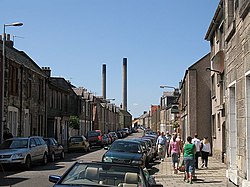
Cockenzie and Port Seton
Cockenzie and Port Seton est une ville située dans l'East Lothian, en Écosse. En 2020 la population de Cockenzie and Port Seton est estimée à 5 370 habitants.
Nearby Places View Menu

0 m
Cockenzie and Port Seton
Cockenzie and Port Seton (Scots: Cockennie [ˈkukɪne]; Scottish Gaelic: Cùil Choinnich, lit. 'cove of Kenneth') is a unified town in East Lothian, Scotland. It is on the coast of the Firth of Forth, four miles east of Musselburgh. The burgh of Cockenzie was created in 1591 by James VI of Scotland. Port Seton harbour was built by the 11th Lord Seton between 1655 and 1665.
The town had a population of 4,493 in 2001. Since the last census in 2001, many new houses have been built. The population is
5,370 as of 2020. Cockenzie and Port Seton has continued to grow over the years and is now a dormitory town for Scotland's capital city, Edinburgh.

606 m
Cockenzie power station
Cockenzie power station was a coal-fired power station in East Lothian, Scotland. It was situated on the south shore of the Firth of Forth, between the town of Prestonpans and the villages of Cockenzie and Port Seton, 8 mi (13 km) east of the Scottish capital of Edinburgh. The station dominated the local coastline with its distinctive twin chimneys from 1967 until the chimneys' demolition in September 2015. Initially operated by the nationalised South of Scotland Electricity Board, it was operated by Scottish Power following the privatisation of the industry in 1991. In 2005 a WWF report named Cockenzie as the UK's least carbon-efficient power station, in terms of carbon dioxide released per unit of energy generated.
The 1,200 megawatt power station ceased generating energy on 15 March 2013 around 8.30am. There are plans to replace the station with a combined cycle gas turbine (CCGT) power station. The removal of the power station was done in stages with the twin chimneys and turbine hall being demolished in a controlled explosion on 26 September 2015, the front section of the boiler house on 4 November 2015 and the rest of the boiler house on 17 December 2015. This was the last remaining major structure to be removed.

1.0 km
Tranent to Cockenzie Waggonway
The Tranent to Cockenzie Waggonway was an early waggonway, possibly the first in Scotland, opened in 1722. It was 2+1⁄2 miles (4 km) long and connected coal pits at Tranent with the salt pans at Cockenzie and harbour at Port Seton in East Lothian. The track was wooden, and wagons were drawn by horses. The Battle of Prestonpans in 1745 was fought across the line.
It was converted to use iron rails in 1815, and was connected to the new main line North British Railway from 1846, later becoming superseded by a branch line of that railway. A section of the original line of route was still in railway use until 1968. Some of the route can be traced at the present day.

1.0 km
Prestonpans
Prestonpans ( Scottish Gaelic: Baile an t-Sagairt, Scots: The Pans) is a mining town, situated approximately eight miles east of Edinburgh, Scotland, in the council area of East Lothian. The population as of 2020 is
10,460. It is near the site of the 1745 Battle of Prestonpans (first called the Battle of Gladsmuir, then renamed the Battle of Tranent, and later still renamed the Battle of Prestonpans – although evidence shows the battle occurred a few miles outside of town). Prestonpans is famous for its murals, with many such artworks depicting local history.

1.2 km
Preston Lodge High School
Preston Lodge High School is a six-year non-denominational school located in Prestonpans, Scotland. It serves students from Cockenzie,Port Seton, Prestonpans,Longniddry, Blindwells and the surrounding areas.