

 English
 Français

Preston Lodge High School
Preston Lodge High School is a six-year non-denominational school located in Prestonpans, Scotland. It serves students from Cockenzie,Port Seton, Prestonpans,Longniddry, Blindwells and the surrounding areas.
Nearby Places View Menu

516 m
Prestonpans
Prestonpans ( Scottish Gaelic: Baile an t-Sagairt, Scots: The Pans) is a mining town, situated approximately eight miles east of Edinburgh, Scotland, in the council area of East Lothian. The population as of 2020 is
10,460. It is near the site of the 1745 Battle of Prestonpans (first called the Battle of Gladsmuir, then renamed the Battle of Tranent, and later still renamed the Battle of Prestonpans – although evidence shows the battle occurred a few miles outside of town). Prestonpans is famous for its murals, with many such artworks depicting local history.

584 m
Tranent to Cockenzie Waggonway
The Tranent to Cockenzie Waggonway was an early waggonway, possibly the first in Scotland, opened in 1722. It was 2+1⁄2 miles (4 km) long and connected coal pits at Tranent with the salt pans at Cockenzie and harbour at Port Seton in East Lothian. The track was wooden, and wagons were drawn by horses. The Battle of Prestonpans in 1745 was fought across the line.
It was converted to use iron rails in 1815, and was connected to the new main line North British Railway from 1846, later becoming superseded by a branch line of that railway. A section of the original line of route was still in railway use until 1968. Some of the route can be traced at the present day.
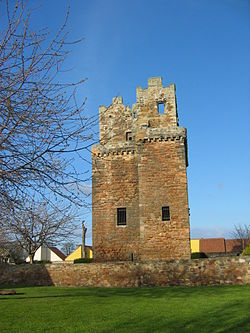
659 m
Preston Tower, East Lothian
Preston Tower is a ruined L-plan keep in the ancient Scottish village of Prestonpans. It is situated within a few metres of two other historic houses, Hamilton House and Northfield House.
664 m
Ding Dong tree
The Ding Dong tree is a Copper beech tree (Fagus sylvatica f. purpurea) in Prestonpans, Scotland, named Scotland's Tree of the Year in 2016. It achieved 8th place in the European Tree of the Year Award the following year. Although young compared to other trees in these annual competitions, the Ding Dong Tree was recognised as having become 'central to the life and identity of the school' on whose grounds it sits, and a prominent example of 'what individual trees can mean to people'.