

 English
 Français

Salthouse Dock
Salthouse Dock is a dock on the River Mersey, England, and part of the Port of Liverpool. It is situated in the southern dock system, connected to Canning Dock to the north, Wapping Dock via Wapping Basin to the south and Albert Dock to the west.
Nearby Places View Menu
179 m
Canning railway station
Canning railway station (previously Custom House station) was a railway station on the Liverpool Overhead Railway.
It was opened on 6 March 1893 by the Marquis of Salisbury, originally as Custom House station, due to its nearby location to Custom House, Liverpool, which was heavily bombed during The Blitz. After Customs moved to a new building the station was renamed Canning in 1947, so as not to confuse passengers. Providing access to Custom House and a number of other busy work locations, Canning was one of the busiest stations on the railway.
The station closed, along with the rest of the line on 30 December 1956. No evidence of this station remains.
182 m
Albert Dock Traffic Office
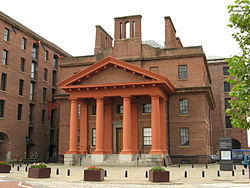
The Albert Dock Traffic Office, officially the Dr Martin Luther King Jr Building, is a 19th-century Grade I listed building located in Liverpool, England. It is one of a series of buildings that make up the Royal Albert Dock. The building was formerly occupied by Granada Television, and is now owned by National Museums Liverpool and houses part of the International Slavery Museum.

195 m
Royal Albert Dock, Liverpool
The Royal Albert Dock is a complex of dock buildings and warehouses in Liverpool, England. Designed by Jesse Hartley and Philip Hardwick, it was opened in 1846, and was the first structure in the United Kingdom to be built from a combination of cast iron, brick, and stone without also using wood for any structural element. As a result, it was the first non-combustible warehouse system in the world. It was known simply as the Albert Dock until 2018, when it was granted a royal charter and had the honorific "Royal" added to its name.
At the time of its construction, the dock was considered to be revolutionary in its design because ships were loaded and unloaded directly from or to the warehouses. Two years after it opened, it was modified to feature the world's first hydraulic cranes. Due to its open yet secure design, the dock became a popular store for valuable cargoes such as brandy, cotton, tea, silk, tobacco, ivory and sugar. However, despite its advanced design, the rapid development of shipping technology meant that, within 50 years, larger and more open docks were required, although the Albert Dock remained a valuable store for cargo.
During the Second World War, the dock was requisitioned by the Admiralty serving as a base for ships of the British Atlantic Fleet. The complex was damaged during air raids on Liverpool, notably during the May Blitz of 1941. In the aftermath of the war, the financial problems of the owners and the general decline of docking in the city meant that the future of the Albert Dock was uncertain. Numerous plans were developed for the re-use of the buildings but none came to fruition and in 1972 the dock was finally closed. Having lain derelict for nearly ten years, the redevelopment of the dock began in 1981, when the Merseyside Development Corporation was set up, with the Albert Dock being officially re-opened in 1984.
Today the Royal Albert Dock is a major tourist attraction in the city and the most visited multi-use attraction in the United Kingdom, outside London. The five warehouses which make up the complex cover 1.25m sq ft in size, the biggest such group of Grade I listed buildings anywhere in the UK.

205 m
The Beatles Story
The Beatles Story is a museum in Liverpool about the Beatles and their history. It was devised and created by Mike and Bernadette Byrne and officially opened on 1 May 1990. It is located on the historical Royal Albert Dock, and is owned by Mersey Ferries, part of Merseytravel.
The Beatles Story contains recreations of The Casbah Coffee Club, The Cavern Club and Abbey Road Studios among other historical Beatles items, such as John Lennon's spectacles, George Harrison's first guitar and a detailed history about the British Invasion and the solo careers of every Beatle. The museum was also recognised as one of the best tourist attractions of the United Kingdom in 2015. The exhibition was preceded by the Cavern Mecca (1981–1984) and Beatles City (1984–1986).