

 English
 Français
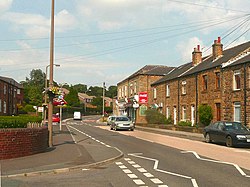
Flockton
Flockton is a village in the civil parish of Kirkburton, in Kirklees, West Yorkshire, England. It is halfway between Huddersfield and Wakefield. In 2020, the population of Flockton and Flockton Green was estimated to be 2,107. Its name derives from Flóki, an Old Norse personal name, and tūn, which is Old English for enclosure or fence.
Nearby Places View Menu

345 m
Flockton Collieries
The Flockton Collieries were small, shallow coal pits that exploited the coal seams north of the village of Flockton in the West Riding of Yorkshire, England. The coal seams, the Flockton Thick, which was up to 48 inches, and the Flockton Thin at about 15 inches, were named from where they outcropped.
In the 17th century, coal master, Richard Carter who died around 1700, made his fortune from the pits, some of which he used to build the village's first church, almshouses and the school. The coal was sold locally until the River Calder was made navigable above Wakefield after 1758.

1.5 km
Briestfield
Briestfield is a hamlet south of Dewsbury, in the Kirklees district of West Yorkshire, England.
It formed part of the township of Whitley Lower in the ancient parish of Thornhill. Whitley Lower was a separate civil parish after 1866, being absorbed back into Thornhill in 1896, which in turn was absorbed into the borough of Dewsbury in 1910.
1.7 km
HM Prison New Hall
HMP New Hall is a closed-category prison for female adults, juveniles, and young offenders. The prison is located in the village of Flockton (near Wakefield) in West Yorkshire, England. New Hall is operated by His Majesty's Prison Service.

1.7 km
Caphouse Colliery
Caphouse Colliery, originally known as Overton Colliery, was a coal mine in Overton, near Wakefield, West Yorkshire, England. It was situated on the Denby Grange estate owned by the Lister Kaye family, and was worked from the 18th century until 1985. It reopened as the Yorkshire Mining Museum in 1988, and is now the National Coal Mining Museum for England.