

 English
 Français

Briestfield
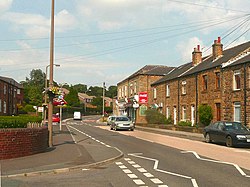
Briestfield is a hamlet south of Dewsbury, in the Kirklees district of West Yorkshire, England. It formed part of the township of Whitley Lower in the ancient parish of Thornhill. Whitley Lower was a separate civil parish after 1866, being absorbed back into Thornhill in 1896, which in turn was absorbed into the borough of Dewsbury in 1910.
Nearby Places View Menu

659 m
Grange Moor
Grange Moor is a village in the civil parish of Kirkburton, in the Kirklees district of West Yorkshire, England, between Huddersfield (6 miles (10 km) away) and Wakefield (9 miles (14 km) away). In 2019, it had an estimated population of 1,101.
The village is represented on Kirkburton parish council and is in the Kirkburton ward of Kirklees Council.
Grange Moor is on moorland with the same name and is to the north of a road junction on the A642, A637 and B6118 roads. Shuttle Eye Colliery was near the crossroads, its site now being occupied by warehousing.
The local church is dedicated to St Bartholomew. See 'External Links' below for a survey of the burials in the churchyard.
Grange Moor Brass Band was formed 1854, and has had a band room in the village since 1937.
During the Second World War, a V-1 missile fell in the area.

1.1 km
Shuttle Eye Colliery
Shuttle Eye Colliery was a coal mine on the West Yorkshire Coalfield at Grange Moor between Wakefield and Huddersfield on the A642 road, in England.
The colliery was started in 1862 by Lockwood and Elliott and had two shafts, the deepest 288 yards. It produced coal from the Beeston and Black Bed seams. Two drift mines at Gregory Spring in Hopton near Mirfield to the north were linked to Shuttle Eye in 1962. The colliery was nationalised in 1947. It closed in 1973.
In 1896 the colliery had 86 underground workers and 13 on the surface. By 1923 the workforce numbered 179 and 175 ten years later. At nationalisation the colliery had 234 underground and 40 surface workers. The colliery employed 222 workers in the 1970s.
After the closure of the colliery, the site has been overbuilt with warehouses.
1.5 km
Flockton
Flockton is a village in the civil parish of Kirkburton, in Kirklees, West Yorkshire, England. It is halfway between Huddersfield and Wakefield. In 2020, the population of Flockton and Flockton Green was estimated to be 2,107.
Its name derives from Flóki, an Old Norse personal name, and tūn, which is Old English for enclosure or fence.

1.5 km
Flockton Collieries
The Flockton Collieries were small, shallow coal pits that exploited the coal seams north of the village of Flockton in the West Riding of Yorkshire, England. The coal seams, the Flockton Thick, which was up to 48 inches, and the Flockton Thin at about 15 inches, were named from where they outcropped.
In the 17th century, coal master, Richard Carter who died around 1700, made his fortune from the pits, some of which he used to build the village's first church, almshouses and the school. The coal was sold locally until the River Calder was made navigable above Wakefield after 1758.