

 English
 Français

La Galerie nationale d'Écosse (en anglais : Scottish National Gallery ; en scots : Scots Naitional Gailerie et en gaélique écossais : Gailearaidh Nàiseanta na h-Alba) est le musée d'art national d'Écosse, situé à Édimbourg et regroupant les collections de peinture et de sculpture. Comme pour les autres musées nationaux britanniques, l'entrée est gratuite.
1. Historique
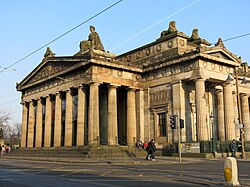
Construit dans un style néoclassique, il s'élève sur la colline de The Mound (en), entre deux portions des Princes Street Gardens. Le bâtiment, conçu par William Henry Playfair, ouvrit ses portes en 1859. Il abrite la plus grande collection d'Écosse de sculptures et de peintures européennes allant de la Renaissance au Post-Impressionnisme.
1. Œuvres d'art du musée


1. = Principaux tableaux =
Sandro Botticelli : La Vierge adorant l'Enfant Jésus endormi Paul Cézanne : Montagne Sainte-Victoire John Constable : La Vallée de Dedham Edgar Degas : Portrait de Diego Martelli Eugène Delacroix : Arabes jouant aux échecs Le Dominiquin : L'Adoration des bergers William Etty : Le Combat : une femme implorant pour le vaincu Thomas Gainsborough : Portrait de Mrs Mary Graham Paul Gauguin : Vision après le Sermon François Gérard : Portrait de Mary Nisbet Hugo van der Goes : Retable de la Trinité Francisco de Goya : El médico Le Greco : Fábula Saint Jérôme en pénitence Bénédiction du Christ Jean-Baptiste Greuze : Jeune Fille qui pleure son oiseau mort Edwin Landseer : The Monarch of the Glen Claude Monet : Meules de foin Peupliers sur l'Epte Giovanni Battista Pittoni : Saint Jérôme et Pierre d'Alcantara Nicolas Poussin : Les Sept Sacrements Henry Raeburn : The Skating Minister Raphaël : Madone Bridgewater La Sainte Famille au palmier Madonna del Passeggio Rembrandt : Jeune Femme au lit Autoportrait à 51 ans Joshua Reynolds : The Ladies Waldegrave Auguste Renoir : La Promenade Rubens : Le Festin d'Hérode Titien : Les Trois Âges de l'homme Diane et Actéon (tableau acheté en 2009 conjointement avec la National Gallery de Londres, et présenté par roulement) Vénus anadyomène Diane et Callisto John Singer Sargent : Portrait de Lady Agnew of Lochnaw Diego Vélasquez : Vieille femme faisant frire des œufs Johannes Vermeer : Le Christ dans la maison de Marthe et Marie Paul Véronèse : Mars et Vénus avec Cupidon et un chien Antoine Watteau : Les Fêtes vénitiennes Le Dénicheur de moineaux
1. = Principales sculptures =
Buste de Carlo Antonio dal Pozzo, du Bernin Les Trois Grâces, d'Antonio Canova (propriété conjointe avec le Victoria & Albert Museum de Londres)
1. = Quelques artistes =
Eugène Boudin (1824-1898) : Plougastel, pêcheuses de crevettes (1871). Andrew Geddes (1783–1844) Alexander Keirincx : Seton Palace and the Forth Estuary (1639), Falkland Palace and the Howe of Fife (1639). Horatio McCulloch (1806-1867) William York Macgregor (1855-1923) William MacTaggart (en) (1903-1981) Lorenzo Monaco Eduardo Paolozzi John Phillip (1817–1867) Henry Raeburn Allan Ramsay Joshua Reynolds Robert Scott Lauder (1803–1869) Diego Velázquez Paolo Veronese Antoine Watteau David Wilkie William Henry Worthington (ca. 1795 - ap. 1839)
1. Galerie


1. Notes et références


1. Annexes


1. = Articles connexes =
Liste de musées au Royaume-Uni Galeries nationales d'Écosse
1. = Liens externes =
(en) Site officiel Ressources relatives aux beaux-arts : Art UK (lieux d'art) Google Arts & Culture Royal Academy of Arts Union List of Artist Names Ressource relative à l'architecture : Structurae
Les Galeries nationales d'Écosse sur l'Institut culturel de Google Portail des musées Portail des arts Portail du néo-classicisme Portail de l’Écosse
Nearby Places View Menu

Scottish National Gallery

The Mound

Bust of Carlo Antonio del Pozzo
Royal Scottish Academy Building
