

 English
 Français

Roman column, York
Roman column, York, is a surviving element of the Roman presence in York, England, located just south of York Minster. Dating to the early 2nd century AD, it originally formed part of the headquarters building (principia) of Eboracum, the Roman name for York. It is one of the few visible examples of Roman architecture in the north of England.
Nearby Places View Menu

19 m
10 Minster Yard
10 Minster Yard is an historic building in the city of York, North Yorkshire, England. A Grade II listed building, located at the corner of Minster Gates at Minster Yard, the building dates to around 1763. It was part of the now-closed Minster School, and was built as the home of dean John Fountayne. 10 Minster Gates is located in the rear of the building.
It is almost a century older than the buildings behind it, numbers 2–8 Minster Gates, which are not on the same alignments as 10 Minster Yard and 10 and 10a Minster Gates.

31 m
9 Minster Gates
9 Minster Gates is an historic building in the city of York, North Yorkshire, England. A Grade II listed building, located on Minster Gates at Minster Yard, the building dates to around 1755.

32 m
The Adams House, York
The Adams House is a historic building in the city centre of York, in England.
The house lies on Low Petergate, one of the main streets in the centre of York. It was built in 1772, for John Fountayne, the Dean of York. It originally incorporated a ground floor passageway through which the Deanery could be accessed. Construction cost £1,353 (equivalent to £218,463 in 2023), and the building was immediately let to one of the cathedral vergers, who then sub-let it. At a later date, the ground floor was converted into a shop, incorporating the former passageway.
The building was Grade II* listed in 1954. For some time, it was a branch of Café Rouge, before becoming Jimmy's cafe-bar, and in 2022, a Fat Hippo burger bar.
The three-storey building is built of brick on a stone base. The original entrance doorway survives, with a second entrance having been created when the passageway was removed; the remainder of the ground floor facade is a shopfront, in similar style. There is a decorated cornice, and an original drainpipe head, with the crest of an elephant, the emblem of Fountayne. The rear facade is plainer, with various sash windows, and some blocked windows.
Inside, the ground floor has been altered, but many rooms on the upper floors retain their original plasterwork and fireplaces, the grandest being in the first floor saloon. Two original staircases also survive.
34 m
York Minster
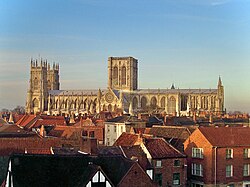
York Minster, formally the Cathedral and Metropolitical Church of Saint Peter in York, is an Anglican cathedral in the city of York, North Yorkshire, England. The minster is the seat of the archbishop of York, the second-highest office of the Church of England, and is the mother church for the diocese of York and the province of York. It is administered by its dean and chapter. The minster is a Grade I listed building and a scheduled monument.
The first record of a church on the site dates to 627; the title "minster" also dates to the Anglo-Saxon period, originally denoting a missionary teaching church and now an honorific. The minster undercroft contains re-used fabric of c. 1160, but the bulk of the building was constructed between 1220 and 1472. It consists of Early English Gothic north and south transepts, a Decorated Gothic nave and chapter house, and a Perpendicular Gothic eastern arm and central tower.
The minster retains most of its medieval stained glass, a significant survival among European churches. The east window, which depicts the Last Judgment, is the largest expanse of medieval stained glass in the world. The north transept contains the Five Sisters window, which consists of five lancets, each over 53 feet (16.3 m) high, filled with grisaille glass.