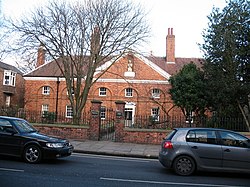
Wandesford House is an 18th-century almshouse in the centre of York, England, one of 12 still-functioning almshouses in the city, and the oldest still in its original building. Built in 1739 and opened in 1743, the house is an important example of the classical style in the city. Like many historic almshouses, it was referred to as a hospital before that term became chiefly associated with medical establishments. The almshouse lies a few yards outside the city walls on the north-west side of Bootham behind its front garden and between houses of a later date. Inside are 12 flats intended for single Christian women who are in hardship, need or distress, and over 50 years of age. Wandesford House is Grade II* listed by Historic England and is owned and run by Mary Wandesford's charity (the Wandesford Trust; charity reg. 251379). The archives of the charity are held at the Borthwick Institute for Archives, University of York.

Nearby Places View Menu
Location Image
30 m

Bootham

Bootham is a street in the city of York, England, leading north out of the city centre. It is also the name of the small district surrounding the street.
Location Image
45 m

47 Bootham

47 Bootham is a historic building on Bootham, a street leading north from the city centre of York in England. The house was commissioned by Mary Thompson, the widow of Edward Thompson. It was designed by John Carr, and was completed in 1753. After Thompson's death, the house was purchased by Leonard Pickard, and it remained in his family until it was purchased by Bootham School, becoming part of the school premises. In the 19th century, the rear bay window was heightened to three storeys, and the second floor was partly remodelled. The building was Grade II* listed in 1954. The house is built of brick, with painted stone dressings, and a slate roof. It is three storeys tall with a cellar, and four bays wide. There are two stucco bands between the ground and first floors. The windows are sashes, and those on the ground floor have shutters. The front door is in the left bay, and it has a small window above, an architrave and a cornice. There is an original lead drainpipe, with a monogram, probably the initials of Thompson. The chimney is central in the building. The house retains most of its original fittings, including the cornices and architraves. The former dining room has panelling above a dado rail, a decorative frieze above the door, and an elaborate fireplace surround. The main staircase is original, and it has a Rococo ceiling above, the design incorporating foliage, the work described by Nikolaus Pevsner as "excellent". The saloon, at the front of the first floor, has an ornate fireplace with an overmantel depicting fruit, flowers and foliage. The servants' staircase is also original, and on the second floor, the queen post roof structure is visible.
Location Image
58 m

49 Bootham

49 Bootham is a historic building on Bootham, a street leading north from the city centre of York in England. The building was constructed in the late 17th century, as two semi-detached houses, each two storeys tall, with an attic. In about 1738, the houses were combined, an extra storey being added to the front section, and the whole building refronted. The doorway was altered in the late 18th century, around the time that the house was sold to Richard Vanden-Bempde-Johnstone. The house was purchased by Bootham School in 1846, becoming the home of the headmaster. From 1875 to 1882, Joseph Rowntree rented it from the school as his house, something commemorated by a plaque. The house was Grade II* listed in 1954, and its rear section was rebuilt in 1965. It remains part of Bootham School. The building is constructed of brick, with painted stone dressings and a slate roof. It is three storeys tall, and four bays wide, the front including quoins and two bands separating the storeys. The doorway has a fanlight and a doorcase with fluted pilasters, while the windows are sashes. There is a basement, enclosed by iron railings. Inside, many fittings date from 1738, including panelling, fireplaces, and the main staircase. The cornice and some moulded ceiling beams survive from the 17th century.
Location Image
77 m

51 Bootham

51 Bootham is a historic building on Bootham, a street leading north from the city centre of York in England. The building was designed by Peter Atkinson for Richard Vanden-Bempde-Johnstone and was completed in or shortly after 1804. It was initially known as "Bootham House". In 1846, Bootham School purchased and relocated to the building. The school redesigned the rear wing and extended it. The rearmost part of the building was destroyed in a fire in 1899. In about 1902, it was replaced by a science block (now the John Bright Library) and a gymnasium, designed by Fred Rowntree and W. H. Thorp in the arts and crafts style. In about 1956, the block was altered by Colin Rowntree, work including dividing the gymnasium into classrooms. The building was Grade II* listed in 1954. The front to Bootham is of brick with stone dressings and a slate roof. It is three storeys tall, with attics and a basement, and is five bays wide. There are sash windows, becoming less elaborate with each storey, and three dormer windows in the attic. At first floor level there is an iron balcony running the whole width of the building. The door has a fanlight and a Doric portico. The 1902 extension is built of red brick with terracotta dressings. It has an entrance front facing southeast, the door of which has a doorcase in the Ionic order. This section consists of various wings, each of which is two storeys tall. The library section has bow windows and an octagonal wooden cupola. Inside, the original section has a stone staircase and several original fireplaces, while the 1902 block has panelled classrooms, and a stone staircase with an Art Nouveau balustrade. The library has built-in shelves and a bronze memorial plaque to John Bright.