

 English
 Français
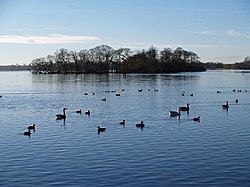
Hornsea Mere is the largest freshwater lake in Yorkshire, England, and lies to the west of Hornsea in the East Riding of Yorkshire. The mere was used as a base for the Royal Naval Air Service and then latterly, the Royal Air Force during the First World War.
Nearby Places View Menu

2.0 km
Wassand
Wassand is a hamlet in the East Riding of Yorkshire, England. It is situated approximately 3 miles (4.8 km) west of Hornsea and to the south of the A1035 road (formerly B1244).
It forms part of the civil parish of Seaton.
The name Wassand derives from the Old Norse vaðsandr meaning 'sand ford'.
Wassand Hall is a large Regency house overlooking Hornsea Mere. The hall was designated a Grade II* listed building in March 1952 and is now recorded in the National Heritage List for England, maintained by Historic England.
Wassand was served from 1865 to 1953 by Wassand railway station on the Hull and Hornsea Railway.

2.0 km
Wassand Hall
Wassand Hall is a large Regency house situated to the west of Hornsea, East Riding of Yorkshire, England, overlooking Hornsea Mere, which is part of its estate. The hall was designated a Grade II* listed building in March 1952 and is now recorded in the National Heritage List for England, maintained by Historic England. The Hall contains a collection of 18th and 19th Century paintings, English and Continental Silver, furniture, and a collection of porcelain.
The estate has been in the possession of the Constable family since about 1520. It was rebuilt in 1815 during the Regency period, the original house having been demolished because it had fallen into disrepair. Ownership passed to a widow, Lady Ernestine Strickland-Constable in 1975. Upon her death in 1995, the estate became held by her great-nephew, Rupert Russell, who resides at Wassand Hall with his wife Catherine.
During World War II, the house was requisitioned by the army and was used by the Free French.

2.3 km
Goxhill, East Riding of Yorkshire
Goxhill is a small hamlet in the civil parish of Hatfield, in the East Riding of Yorkshire, England in an area known as Holderness. It is situated approximately 2 miles (3.2 km) south-west of Hornsea town centre. In 1931 the parish had a population of 70.
On 1 April 1935 the parish was abolished and merged with Great Hatfield and Little Hatfield to form Hatfield.
The name Goxhill could perhaps be derived from the Old Norse geysill meaning 'a gush of water'.
The parish church of St Giles is a Grade II listed building.
In 1823, Goxhill parish was in the Wapentake and Liberty of Holderness. At the time, the parish church was undergoing repairs, begun in 1818. The population was 70, which included five farmers. In 1840 the population was 65, again with five farmers, the parish land of 880 acres (3.6 km2) the property of Rev Charles Constable, who had been patron of the St Giles Church incumbent since 1823.
Goxhill was served from 1865 to 1953 by Wassand railway station on the Hull and Hornsea Railway.

2.6 km
Wassand railway station
Wassand railway station was a railway station that served the villages of Wassand and Goxhill in the East Riding of Yorkshire, England. It was on the Hull and Hornsea Railway.
It opened in 1865, and was originally named "Goxhill". It was renamed "Wassand" (to avoid confusion with Goxhill in Lincolnshire) on 1 October 1904, and closed on 21 September 1953.