

 English
 Français

Kwik Fit
Kwik Fit est une entreprise écossaise, leader européen de l'entretien et réparation rapide automobile, dont le siège est situé à Broxburn, West Lothian en Écosse.
Nearby Places View Menu

40 m
1 The Avenue
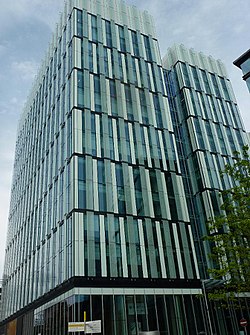
1 The Avenue is a building in Spinningfields, Manchester, England. It is situated on Deansgate adjacent to the Grade I listed John Rylands Library.
57 m
3 Hardman Street
3 Hardman Street is a 16-storey high-rise building in Spinningfields, Manchester, England. At 75 m (246 ft), as of 2023 it is the third-tallest building in the Spinningfields area (after 1 Spinningfields and the Manchester Civil Justice Centre) and the joint 36th-tallest building in Greater Manchester.
Its nearest airport is Manchester Airport, located 8.7 miles away; the nearest train station is Deansgate, located 0.4 miles away; and the nearest bus stop is Cheapside (Stop CO), which is located 0.3 miles away.

71 m
Manchester Library & Information Service
There are 24 public libraries in Manchester, England, including the famous Central Library in St Peter’s Square.
The oldest community library still in use is Levenshulme Library in South Manchester, built in 1903. Levenshulme Library is also a Carnegie library, having been built with money donated by Scottish-American businessman and philanthropist Andrew Carnegie, who funded the building of over 2,500 libraries across the world. Two new multimillion-pound libraries have recently opened in North Manchester as part of a major regeneration scheme, including the eco-designed North City Library in Harpurhey. and The Avenue Library and Learning Centre in Higher Blackley.

83 m
John Rylands Research Institute and Library
The John Rylands Research Institute and Library is a late-Victorian neo-Gothic building on Deansgate in Manchester, England. It is part of the University of Manchester. The library, which opened to the public in 1900, was founded by Enriqueta Augustina Rylands in memory of her husband, John Rylands. It became part of the university in 1972, and now houses the majority of the Special Collections of The University of Manchester Library, the third largest academic library in the United Kingdom .
Special collections built up by both libraries were progressively concentrated in the Deansgate building. The special collections, believed to be among the largest in the United Kingdom, include medieval illuminated manuscripts and examples of early European printing, including a Gutenberg Bible and a Mainz Psalter, the second largest collection of printing by William Caxton, and the most extensive collection of the editions of the Aldine Press of Venice. The Rylands Library Papyrus P52 has a claim to be the earliest extant New Testament text. The library holds personal papers and letters of notable figures, among them the novelist Elizabeth Gaskell and the scientist John Dalton.
The architectural style is primarily neo-Gothic with elements of the Arts and Crafts movement in the ornate and imposing gatehouse, facing Deansgate, which dominates the surrounding streetscape. The library, granted Grade I listed status in 1994, is maintained by the University of Manchester and open for library readers and visitors.
The library is one of the museum, library and archive collections of national and international importance under the Designation Scheme for England. As of 2020, 152 collections are officially designated.

98 m
Lincoln House, Manchester
Lincoln House was an office building on Deansgate in Manchester, England. It was designed in the 1980s by Holford Associates. It was completely clad in glass and was designed as a deliberate response to the 1960s and 1970s Brutalist architecture common in many British cities. It was built in 1986 for the Lincoln House Chambers, a legal practice based in Manchester.
By the 1980s, the Manchester City Council Planning Department rejected Brutalist proposals in the city believing such buildings to be cold and depressing pieces of architecture. The department were instead inclined to approve safe architecture such as brick buildings. Holford Associates set about fulfilling this move forward by proposing a glass building which demonstrated the latest technologies and improvements in neoprene sealants.
It was demolished in 2017, as part of a redevelopment called 125 Deansgate.