

 English
 Français

Glasgow Cross railway station
Glasgow Cross was a railway station in the city centre of Glasgow.
Nearby Places View Menu
36 m
Merchant City Festival
The Merchant City Festival is a major cultural festival taking place in Glasgow's Merchant City area.
Attracting more than 55,000 people, the four-day Festival presents the cream of Scotland's theatre, music, visual arts, comedy, dance, film, fashion and food scene.
The Festival presents opera singers in the courtyards and squares performing alongside cutting-edge live art, street theatre, iconoclastic comedy and music from every genre in the bars and on the street. It also has a quirky short film programme that places films in estate agents, hairdressers and tattoo parlours. Many of the events are free of charge.
The Merchant City Festival has attracted an extensive range of supporters and contributors from festival directors to national organisations such as Scottish Opera, Scottish Ballet and BBC Scottish Symphony Orchestra.
A 'festival of festivals', it has worked with established festivals such as New Moves International, the Glasgow International Comedy Festival, Glasgow International Jazz Festival, Big in Falkirk and Glasgay! An international context is provided by the Directors' Choice programme that provides a remarkable range of street artists selected from festival directors throughout Europe.
The 2008 Merchant City Festival was held in September.
The Merchant City Festival is produced by UZ Events in partnership with Glasgow City Marketing Bureau.
Celtic Music Radio broadcast live from the 2008 festival on 1530 kHz and on the internet, from an Outside Broadcast location in Merchant Square.

39 m
Glasgow Tolbooth
The Glasgow Tolbooth was a municipal structure at Glasgow Cross, Glasgow, Scotland. The main block, which was the meeting place of the Royal Burgh of Glasgow, was demolished in 1921 leaving only the steeple standing. The steeple is a Category A listed building.

85 m
Collegiate Church of the Blessed Virgin Mary and St Anne, Glasgow
The Collegiate Church of the Blessed Virgin Mary and St Anne, Glasgow, was founded in the middle of the sixteenth century by James Houstoun, Subdean of Glasgow and Rector of the University of Glasgow from 1534 to 1541. The church was located on the south side of Trongate. Two copies of its Latin constitution, dating from 1549, have survived in the city archives. These provide detailed information about the structure of the college and its funding. James Houstoun's original provision was for a Provost, eight canons or prebends, and three choristers, but later benefactions extended this. The prebends were supported by property scattered across the city, and in Dalry, Maybole and Rutherglen.
The third prebend was the organist, who was also in charge of the Song School for the instruction of the youth in plainsong and descant, which stood on the west side of the church. When their voices broke, choristers would continue their education at the Grammar School.
The canons wore fur-trimmed red hoods, and surplices which were to be washed once a year. The daily pattern of services is carefully laid out. St Anne's Day, 26 July, was marked with much pomp and ringing of bells, after which money for bread and ale was distributed to the canons, to thirty paupers, eight scholars, and the residents of the Hospital of St Nicholas by the cathedral. The lepers of St Ninian's Hospital received their share at a safe distance in the churchyard.
At the Reformation in Scotland in 1560, this all came to an end. In 1570, the church was described as ruinous, when it passed into the hands of a city burgess, James Fleming. It later returned to use as a parish church of the Church of Scotland. In the 17th century a gothic spire was built. The church burnt down in 1793, and a new church was built to a classical design but retaining the spire. The kirk was designed by architect James Adam who was the joint architect of the very new Royal Infirmary, and a few years later the architect of the city's Assembly Rooms in Ingram Street. One of its most celebrated ministers was the evangelical and enterprising Rev Dr Thomas Chalmers.
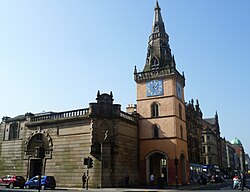
Much later, the Tron congregation merged with St George's on Buchanan Street in 1940 to form St George's Tron Church; after a period of disuse, the building – the Tron Kirk or Laigh Kirk – was converted into the Tron Theatre in the early 1980s.
85 m
Tron Theatre
The Tron Theatre is located in Glasgow, Scotland. The theatre was formerly known as the Tron Kirk. It began as the Collegiate Church of Our Lady and St. Anne.
The Tron Theatre building is home to the Tron Theatre Company and serves as a producing house for contemporary theatrical work. It also acts as a receiving house for a visiting program of theatre, comedy, and music from Scotland, the UK, and abroad. Its Education and Outreach department offers a range of activities, from drama workshops for children and young people to creative writing for adults and professional development opportunities for theatre students and practitioners.