

 English
 Français
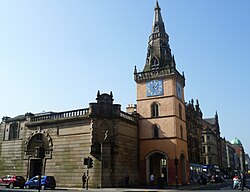
Tron Theatre
The Tron Theatre is located in Glasgow, Scotland. The theatre was formerly known as the Tron Kirk. It began as the Collegiate Church of Our Lady and St. Anne. The Tron Theatre building is home to the Tron Theatre Company and serves as a producing house for contemporary theatrical work. It also acts as a receiving house for a visiting program of theatre, comedy, and music from Scotland, the UK, and abroad. Its Education and Outreach department offers a range of activities, from drama workshops for children and young people to creative writing for adults and professional development opportunities for theatre students and practitioners.
Nearby Places View Menu

0 m
Collegiate Church of the Blessed Virgin Mary and St Anne, Glasgow
The Collegiate Church of the Blessed Virgin Mary and St Anne, Glasgow, was founded in the middle of the sixteenth century by James Houstoun, Subdean of Glasgow and Rector of the University of Glasgow from 1534 to 1541. The church was located on the south side of Trongate. Two copies of its Latin constitution, dating from 1549, have survived in the city archives. These provide detailed information about the structure of the college and its funding. James Houstoun's original provision was for a Provost, eight canons or prebends, and three choristers, but later benefactions extended this. The prebends were supported by property scattered across the city, and in Dalry, Maybole and Rutherglen.
The third prebend was the organist, who was also in charge of the Song School for the instruction of the youth in plainsong and descant, which stood on the west side of the church. When their voices broke, choristers would continue their education at the Grammar School.
The canons wore fur-trimmed red hoods, and surplices which were to be washed once a year. The daily pattern of services is carefully laid out. St Anne's Day, 26 July, was marked with much pomp and ringing of bells, after which money for bread and ale was distributed to the canons, to thirty paupers, eight scholars, and the residents of the Hospital of St Nicholas by the cathedral. The lepers of St Ninian's Hospital received their share at a safe distance in the churchyard.
At the Reformation in Scotland in 1560, this all came to an end. In 1570, the church was described as ruinous, when it passed into the hands of a city burgess, James Fleming. It later returned to use as a parish church of the Church of Scotland. In the 17th century a gothic spire was built. The church burnt down in 1793, and a new church was built to a classical design but retaining the spire. The kirk was designed by architect James Adam who was the joint architect of the very new Royal Infirmary, and a few years later the architect of the city's Assembly Rooms in Ingram Street. One of its most celebrated ministers was the evangelical and enterprising Rev Dr Thomas Chalmers.
Much later, the Tron congregation merged with St George's on Buchanan Street in 1940 to form St George's Tron Church; after a period of disuse, the building – the Tron Kirk or Laigh Kirk – was converted into the Tron Theatre in the early 1980s.

32 m
Trongate
Trongate is one of the oldest streets in the city of Glasgow, Scotland. Trongate begins at Glasgow Cross, where the steeple of the old Glasgow Tolbooth is situated, being the original centre of medieval Glasgow, and goes westward changing its name to Argyle Street at Glassford Street. In modern times, it forms the notional southern boundary of the Merchant City area.

42 m
Merchant City
The Merchant City, a new name introduced through urban renewal by the Scottish Development Agency and the city council in the 1980s is one part of the metropolitan central area of Glasgow. It commences at George Square and goes eastwards reaching Glasgow Cross, in the centre of Glasgow, Scotland. The eastern fringe of the Merchant City contains part of Glasgow's original medieval street plan, which stretches northwards towards neighbouring Townhead.
It contains offices, flats, retail shops, restaurants, and bars. Part of the campus of the University of Strathclyde occupies the area. The Merchant City is home to several repurposed buildings including the City Halls & Old Fruitmarket, Merchant Square, and the Scottish Youth Theatre. It hosts many annual festivals.
The approximate definition of the Merchant City is the area defined by George Street to the north, High Street to the east, Trongate to the south, and Queen Street to the west.
74 m
The 13th Note Café
The 13th Note Café was a restaurant, bar and music venue in Glasgow, Scotland.
From its beginnings on Glassford Street (what is now Bar Bacchus), the 13th Note moved to its present site on King Street in 1997. A few years later, the 13th Note franchise expanded to include a larger club venue on Clyde Street. The holding company that owned both venues went into receivership in November 2001. In the summer of 2002, The 13th Note Club was bought over by the Channelfly Group (owners of the Barfly franchise), leaving only the café venue still open under the original 13th Note name.
The venues of the 13th Note have hosted concerts by a number of notable acts, including Idlewild, Belle & Sebastian and Franz Ferdinand.
Alex Kapranos, the lead singer and guitarist of Franz Ferdinand took over as the music programmer at the Kazoo Club from Jim Byrne of Dexter Slim and the Pickups, who established the successful Kazoo club with his wife Pat. Alex had his first gig at the Kazoo club then became host when the Byrnes gave it up when an entry charge was introduced. Alex also hosted the 99p Club. Another notable music programmer was Brendan O'Hare.