

 English
 Français
Philpstoun railway station
Philpstoun railway station was a railway station in the village of Philpstoun, to the east of Linlithgow in West Lothian, Scotland. It was located on the Edinburgh and Glasgow Railway.
Nearby Places View Menu

790 m
Philpstoun
Philpstoun is a small village in West Lothian, Scotland, situated roughly 2 miles (3.2 km) east of the historic county town of Linlithgow. The village originated in the oil shale mining boom of the 19th century. Surrounded by rich arable farm land, the village has a Community Education Centre and a Category B listed church. Philpstoun railway station closed in 1951 and Philpstoun and District Bowling Club closed in February 2012.
The bulk of the village lies between the Union Canal and the Glasgow–Edinburgh railway line, although the easternmost part, Old Philpstoun, lies north of the railway and closer to the M9 motorway.

1.4 km
Threemiletown
Threemiletown is a village in West Lothian, Scotland. The settlement sits north of Ecclesmachan and west of Winchburgh.

1.5 km
Winchburgh rail crash
The Winchburgh rail crash was a multi-train rail crash that occurred on Monday 13 October 1862, 1+1⁄2 miles (2.4 km) northwest of Winchburgh in Linlithgowshire (now West Lothian). The crash caused 17 deaths (15 passengers and two employees died) and is the fourth most deadly rail accident in Scotland.
1.6 km
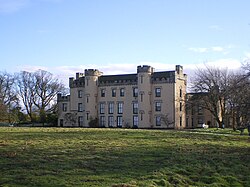
House of the Binns
The House of the Binns, or simply the Binns, is a historic house and estate in West Lothian, Scotland, the seat of the Dalyell baronets and family (pronounced dee el). It dates principally from the early 17th century and was gifted to the National Trust for Scotland in 1944 by Eleanor Dalyell. It was the home of MP Tam Dalyell until his death in January 2017.
The estate spreads over two hills (bens in Gaelic) from which its name is derived, i.e. it is named "the house of the hills". It is set in 200 acres (80 hectares) of parkland, and the house enjoys panoramic views of central Scotland: to the north, across the River Forth to the Highlands, and south over the Pentland Hills. The house contains a collection of porcelain, furniture, and portraits which trace the family's lives and interests through the centuries.