Location Image

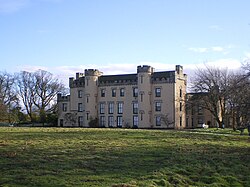
House of the Binns

The House of the Binns, or simply the Binns, is a historic house and estate in West Lothian, Scotland, the seat of the Dalyell baronets and family (pronounced dee el). It dates principally from the early 17th century and was gifted to the National Trust for Scotland in 1944 by Eleanor Dalyell. It was the home of MP Tam Dalyell until his death in January 2017. The estate spreads over two hills (bens in Gaelic) from which its name is derived, i.e. it is named "the house of the hills". It is set in 200 acres (80 hectares) of parkland, and the house enjoys panoramic views of central Scotland: to the north, across the River Forth to the Highlands, and south over the Pentland Hills. The house contains a collection of porcelain, furniture, and portraits which trace the family's lives and interests through the centuries.

Nearby Places View Menu
Location Image
1.4 km

Blackness, Falkirk

Blackness is a small village and harbour at Blackness Bay, an inlet of the Firth of Forth in Scotland. It lies 3.4 mi (5.5 km) east-southeast of Bo'ness, 5.0 mi (8.0 km) west-northwest of South Queensferry and 3.8 mi (6.1 km) north-east of Linlithgow, within the council area of Falkirk. It was formerly part of the historic county of West Lothian. At the 2001 Census Blackness was reported as having a population of around 135 residents.
1.6 km

Philpstoun railway station

Philpstoun railway station was a railway station in the village of Philpstoun, to the east of Linlithgow in West Lothian, Scotland. It was located on the Edinburgh and Glasgow Railway.
Location Image
1.6 km

Philpstoun

Philpstoun is a small village in West Lothian, Scotland, situated roughly 2 miles (3.2 km) east of the historic county town of Linlithgow. The village originated in the oil shale mining boom of the 19th century. Surrounded by rich arable farm land, the village has a Community Education Centre and a Category B listed church. Philpstoun railway station closed in 1951 and Philpstoun and District Bowling Club closed in February 2012. The bulk of the village lies between the Union Canal and the Glasgow–Edinburgh railway line, although the easternmost part, Old Philpstoun, lies north of the railway and closer to the M9 motorway.
Location Image
1.8 km

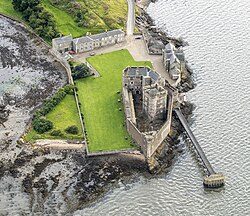
Blackness Castle

Blackness Castle is a 15th-century fortress, near the village of Blackness, Scotland, on the south shore of the Firth of Forth. It was built, probably on the site of an earlier fort, by Sir George Crichton in the 1440s. At this time, Blackness was the main port serving the Royal Burgh of Linlithgow, one of the main residences of the Scottish monarch. The castle, together with the Crichton lands, passed to James II of Scotland in 1453, and the castle has been crown property ever since. It served as a state prison, holding such prisoners as Cardinal Beaton and the 6th Earl of Angus. Strengthened by Sir James Hamilton of Finnart in the mid-16th century, the castle became one of the most advanced artillery fortifications of its time in Scotland. A century later, these defences were not enough to prevent Blackness falling to Oliver Cromwell's army in 1650. Some years after the siege, the castle was repaired, and again served as a prison and a minor garrison. In 1693, the spur protecting the gate was heightened, and the Stern Tower shortened as a base for three heavy guns. Barracks and officers' quarters were added in the 1870s, when the castle was used as an ammunition depot, until 1912. The castle was briefly reused by the army during World War I. It is now a Scheduled Ancient Monument, in the care of Historic Environment Scotland. Because of its site, jutting into the Forth, and its long, narrow shape, the castle has been characterised as "the ship that never sailed". The north and south towers are often named "stem" and "stern", with the central tower called the "main mast".