Location Image

Kettlewell with Starbotton

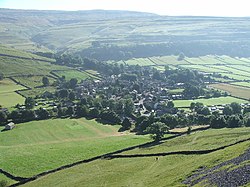
Kettlewell with Starbotton is a civil parish in the county of North Yorkshire, England. Kettlewell is a village in Upper Wharfedale, North Yorkshire, England. It lies between the villages of Grassington, Kilnsey and Conistone to the south, Starbotton to the northwest, the hamlet of Horsehouse to the northeast, and later on Coverdale. Kettlewell nestles at the feet of Great Whernside, and Buckden Pike, where Park Gill Beck joins the River Wharfe, and set to the east of the Wharfe. Both river and beck are joined by attractive stone bridges there. Starbotton is a hamlet of around 70 houses situated in the Yorkshire Dales National Park, by the River Wharfe in Wharfedale. The resident population is only around 75 with many of the village houses being used as holiday accommodation. There are only two remaining working farms - one at either end of the village, the rest having been converted in one way or another. It is on the opposite bank of the River Wharfe to the Dales Way halfway between Kettlewell and Buckden. Until 1974 it was part of the West Riding of Yorkshire. From 1974 to 2023 it was part of the district of Craven, it is now administered by the unitary North Yorkshire Council.

Nearby Places View Menu
Location Image
378 m

Kettlewell Meadows

Kettlewell Meadows is a Site of Special Scientific Interest (SSSI) within Yorkshire Dales National Park, in North Yorkshire, England. It is located in Wharfedale between the villages of Starbotton and Kettlewell. It is protected because of the botanically rich floodplain grassland maintained by a traditional management regime. The long-distance footpath called the Dales Way passes through this protected area. Kettlewell Meadows is adjacent to another protected area called River Wharfe SSSI.
Location Image
1.3 km

Starbotton

Starbotton is a village of around 60 houses in Upper Wharfedale in the county of North Yorkshire, England. It is situated in the Yorkshire Dales National Park, by the River Wharfe. The resident population is around 48 and many village houses are used for holiday accommodation. There are two working farms - one at either end of the village, the rest having been converted for other uses. The village is on the opposite bank of the Wharfe to the Dales Way halfway between Kettlewell and Buckden. Until 1974 it was part of the West Riding of Yorkshire. From 1974 to 2023 it was part of the district of Craven, it is now administered by the unitary North Yorkshire Council.
Location Image
1.6 km

Kettlewell

Kettlewell is a village in Upper Wharfedale, North Yorkshire, England. It lies 6 miles (10 km) north of Grassington, at the point where Wharfedale is joined by a minor road (Cam Gill Road) which leads north-east from the village over Park Rash Pass to Coverdale. Great Whernside rises to the east. The population of the civil parish (Kettlewell with Starbotton) was 322 at the 2011 census, with an estimated population of 340 in 2015. The population was recorded as being at 321 according to the United Kingdom 2021 census. Until 1974 it was part of the West Riding of Yorkshire. From 1974 to 2023 it was part of the district of Craven, it is now administered by the unitary North Yorkshire Council.
Location Image
1.7 km

St Mary's Church, Kettlewell

St Mary's Church is the parish church of Kettlewell, a village in North Yorkshire, in England. There was a church in Kettlewell in the mediaeval period, but it was entirely rebuilt in 1820. Between 1882 and 1885, the nave and chancel were again rebuilt, to a design by T. H. and F. Healey. The building was grade II* listed in 1954. The church is built of stone with a stone slate roof, and consists of a nave, a south porch, a chancel, and a west tower. The tower has three stages, a round-arched south doorway with a keystone, string courses, windows with pointed arches in the middle stage, bell openings with pointed arches and hood moulds in the top stage, and an embattled parapet with corner pinnacles. The windows in the body of the church are in Perpendicular style. Three have mid-20th century stained glass. The font is probably early 12th century and came from the earlier church.