


Preston is a town in New London County, Connecticut, United States. The town is part of the Southeastern Connecticut planning region. Its population was 4,788 at the 2020 census. The town includes the villages of Long Society, Preston City, and Poquetanuck.
Location
3.6 km
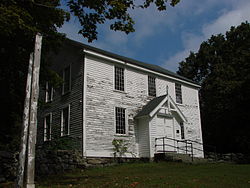
The Long Society Meetinghouse is a historic church building at 45 Long Society Road in Preston, Connecticut. It is one of only about a dozen surviving colonial "broad side" meeting houses, and is the last example surviving in Connecticut that has not been altered from that configuration by the addition of a tower or relocation of its entrance or pulpit. The meeting house was built from 1817 to 1819 on the site of an earlier meetinghouse, incorporating some elements of the earlier building. The meeting house was used both as a church and for civic functions, the reason for its plain, not overtly religious appearance. The building was added to the National Register of Historic Places in 1976.

3.7 km
Hallville Mill Historic District is a historic district in the town of Preston, Connecticut, that was listed on the National Register of Historic Places in 1996. Contributing properties in the district are 23 buildings, two other contributing structures, and one other contributing site over a 50-acre area. The district includes the dam that forms Hallville Pond, historic manufacturing buildings and worker housing, and the Hallville Mill Bridge, a lenticular pony truss bridge built circa 1890 by the Berlin Iron Bridge Company.
Hallville is a historic textile mill village. The first mill on the local stream, Indiantown Brook, was a fulling mill built in 1752 for finishing of locally produced homespun woolen cloth. Carding machines were added in the early 19th century. In 1857 Joseph Hall, Sr., a weaver born in England, built an industrial-scale woolen mill on the site. The mill remained under his family's ownership under the name Hall Brothers' Woolen Mill and was continually expanded over the years. As of 1888 the mill employed 175 workers and produced 860,000 yards of cloth annually. The woolen mill burned in 1943, but manufacturing continued in Hallville until the 1960s. It was a major source of employment and tax revenue for the town of Preston.
The district has significance "as an intact representative small-scale 19th-century mill village containing a high concentration of contributing buildings and structures built as components of a company-owned town based initially on so-called Rhode Island manufacturing system." As such, the mill and its associated village provide physical evidence of the area's economic transition to industrial production during the late 19th century.
Route 2A, a two-lane undivided highway, passes through Hallville. Increased traffic volumes on this road, attributed to the nearby Foxwoods and Mohegan Sun casinos, are considered to be a threat to the historic character of the village.

4.8 km
Poquetanuck is a village in the town of Preston, Connecticut, United States, located near the banks of a bay known as Poquetanuck Cove that opens to the Thames River. The village includes the National Register of Historic Places-listed Poquetanuck Village Historic District.

5.2 km
St. Mary Church is one of two constituent Roman Catholic parish churches in Norwich, CT, USA. Along with Saints Peter and Paul Church, the two parishes represent the Joint Norwich Catholic Cluster. Fr. Robert Washabaugh administer each parish, along with associate deacons and staff.

5.3 km
Greeneville is a neighborhood of the city of Norwich, Connecticut, United States, located northeast of Downtown Norwich along the West Bank of the Shetucket River. Most of the neighborhood is designated Greeneville Historic District, a historic district that is listed on the National Register of Historic Places.
The district was listed on the National Register in 2005 and includes 683 contributing buildings, seven other contributing structures, and one other contributing site over a 300 acres area.
The district is drawn to "correspond to the village as it was laid out in 1833, but also include additional streets laid out and developed in the late nineteenth and early twentieth centuries to accommodate population growth. Areas north and south of the district boundaries were excluded...." as those areas included undeveloped land, or fewer contributing relative to non-contributing buildings, or reflected a "shift in architectural character."
According to the Connecticut Trust for Historic Preservation the district "is a historically significant industrial village that was created to support and sustain water-powered industry from 1828 to about 1940. Much of the enduring success of this industrial enterprise can be attributed to the entrepreneurial vision of industrialist William P. Greene. His development of this planned community and a company to deliver a centralized power system, combined with significant technological infrastructure improvements in the late 19th century, supported the largest industrial presence in Norwich. Although nominally a part of the City of Norwich after 1875, from its creation in 1833 until after World War I Greeneville remained a relatively independent and self-sufficient, working-class community-an evolution fully expressed by the district's large, cohesive collection of generally well-preserved domestic, institutional and commercial architecture. While much of the architecture has the vernacular character expected in a mill town, the district also includes representative examples of the major styles of the period, including Greek Revival, Second Empire, Italianate, and Carpenter Gothic."