


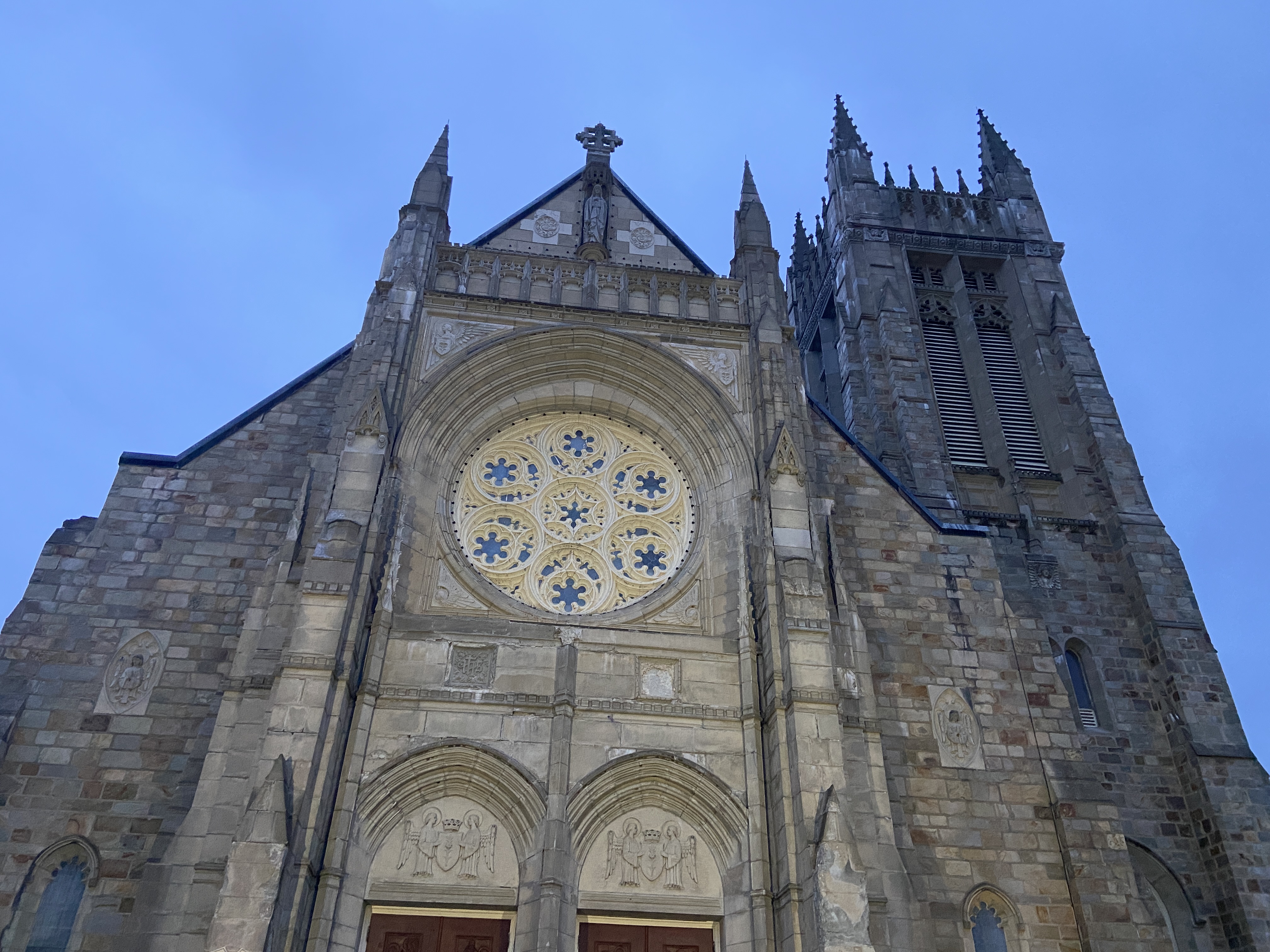
St. Mary Church is one of two constituent Roman Catholic parish churches in Norwich, CT, USA. Along with Saints Peter and Paul Church, the two parishes represent the Joint Norwich Catholic Cluster. Fr. Robert Washabaugh administer each parish, along with associate deacons and staff.
Location

558 m
Greeneville is a neighborhood of the city of Norwich, Connecticut, United States, located northeast of Downtown Norwich along the West Bank of the Shetucket River. Most of the neighborhood is designated Greeneville Historic District, a historic district that is listed on the National Register of Historic Places.
The district was listed on the National Register in 2005 and includes 683 contributing buildings, seven other contributing structures, and one other contributing site over a 300 acres area.
The district is drawn to "correspond to the village as it was laid out in 1833, but also include additional streets laid out and developed in the late nineteenth and early twentieth centuries to accommodate population growth. Areas north and south of the district boundaries were excluded...." as those areas included undeveloped land, or fewer contributing relative to non-contributing buildings, or reflected a "shift in architectural character."
According to the Connecticut Trust for Historic Preservation the district "is a historically significant industrial village that was created to support and sustain water-powered industry from 1828 to about 1940. Much of the enduring success of this industrial enterprise can be attributed to the entrepreneurial vision of industrialist William P. Greene. His development of this planned community and a company to deliver a centralized power system, combined with significant technological infrastructure improvements in the late 19th century, supported the largest industrial presence in Norwich. Although nominally a part of the City of Norwich after 1875, from its creation in 1833 until after World War I Greeneville remained a relatively independent and self-sufficient, working-class community-an evolution fully expressed by the district's large, cohesive collection of generally well-preserved domestic, institutional and commercial architecture. While much of the architecture has the vernacular character expected in a mill town, the district also includes representative examples of the major styles of the period, including Greek Revival, Second Empire, Italianate, and Carpenter Gothic."

1.1 km
The John F. Slater House, also known as the Elks Club, is a historic building in Norwich, Connecticut.
It was built in brick for John Fox Slater around either 1827 or 1843. It was added to the National Register of Historic Places in 1985 as part of the Downtown Norwich Historic District as "the most elaborate Greek Revival building in the downtown", and it is fronted by a monumental Corinthian portico. The design of the house has been attributed to John Bishop, a builder from New London who was responsible for the Huntington Street Baptist Church. The house was later owned by the local lodge of Elks, who used the building as their clubhouse. In 1914-15 they built a large but complementary rear addition, designed by architects Cudworth & Woodworth and contractors Doyle & Murphy, the same team that would build the Willimantic Elks Club ten years later.
The building was vacant as of January 2014.
1.2 km
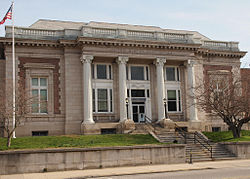
The US Post Office-Norwich Main is located at 340 Main Street in downtown Norwich, Connecticut. Built in 1905 and enlarged in 1938, it is a good local example of Classical Revival architecture, with an unusual level of detail for a period post office. The building was listed on the National Register of Historic Places on July 17, 1986.

1.4 km
The William A. Buckingham House, also known as Buckingham Memorial Hall, is a historic house at 307 Main Street in Norwich, Connecticut. It was built in 1847 by William A. Buckingham, whose later political career included terms as mayor of Norwich and Governor of Connecticut during the American Civil War. It has housed a variety of veterans' service organizations since 1898, as well as government offices. The house was listed on the National Register of Historic Places on April 29, 1982.

1.4 km
Norwich City Hall is the seat of municipal government in Norwich, Connecticut, United States. It is located at Union Street and Broadway, prominently overlooking the city's central business district. Built in 1870-73, when Norwich was still a town, it has served as the seat of municipal government since then. Architecturally it is a prominent statewide example of civic Second Empire architecture, and was listed on the National Register of Historic Places in 1983 for its architecture and history.
Book your tour near
St. Mary's Church
Book Now
4.2
in partnership with
GetYourGuide.com