

 English
 Français

Brathay
Brathay is a hamlet in Skelwith parish in Cumbria, England. Historically part of Lancashire, the hamlet lies close to Clappersgate on the south bank of the River Brathay, and is about 0.9 miles (1.5 km) south west of Ambleside. Brathay Hall is a country house from the late 18th century. The house and the surrounding estate belong to a charity, the Brathay Trust.
Nearby Places View Menu

222 m
Clappersgate
Clappersgate is a village in the Westmorland and Furness Unitary Authority, in the county of Cumbria, England. Clappersgate is located on the B5286 road and on the River Brathay. It is near the town of Ambleside and downstream of Elterwater and Chapel Stile.
The village was once home to a stone skimming club known as the Slate Slingers who utilised the slate washed downstream from quarries, and the large pool located under Clappersgate Bridge.

479 m
Holy Trinity Church, Brathay
Holy Trinity Church is in Bog Lane in the village of Brathay, Cumbria, England. It is an active Anglican parish church in the deanery of Windermere, the archdeaconry of Westmorland and Furness, and the diocese of Carlisle. The church is recorded in the National Heritage List for England as a designated Grade II listed building. The hilltop site for the church was recommended by William Wordsworth who, when describing it in a letter in 1836, said "there is no situation out of the Alps, nor among them, more beautiful than that where this building is placed".
550 m
Ambleside Roman Fort
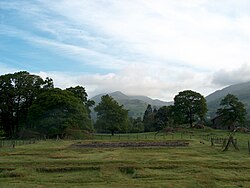
Ambleside Roman Fort is the modern name given to the remains of a fort of the Roman province of Britannia. The ruins have been tentatively identified as those of either Galava or Clanoventa, mentioned in the Antonine Itinerary. Dating to the 1st or 2nd century AD, its ruins are located on the northern shore of Windermere at Waterhead, near Ambleside, in the English county of Cumbria, within the boundaries of the Lake District National Park.
The fort guarded the Roman road from Brougham to the Roman fort of Glannoventa by the sea at Ravenglass, by way of Hardknott Roman Fort. There is also assumed to have been a road south to the fort at Kendal. In 2016 it was reported that LIDAR technology had revealed a Roman road running north from Ambleside fort to Carlisle, and another running northwest to Papcastle. These roads had been previously described by John Horsley in his Britannia Romana of 1732.
The ruins are a Grade I listed structure. The site is open to the public, and is owned and managed by the National Trust. The site is a scheduled monument with list entry numbers of 1009348 and 1244785 (formerly RSM 13567 and RBS 450573)
834 m
Rothay Manor
Rothay Manor is a country house near Ambleside in Cumbria. It is a Grade II listed building.