


Lilaste Station is a railway station on the Zemitāni–Skulte Railway in Latvia. It is located on the outskirts of the village of Lilaste in Carnikava Parish, Ādaži Municipality, 37.2 kilometres (23.1 mi) from Zemitāni. It has a double-track line to Carnikava and a single-track line to Saulkrasti.
Location
1 explorer visited this place
548 m
Lilaste is a village in Carnikava Parish of Ādaži Municipality in the Vidzeme region of Latvia. Located in the north of the parish on the left bank of the Lilaste river between Lake Lilaste and the coast of the Gulf of Riga, north of the Zemitāni–Skulte Railway and the A1 road, 13 km from the parish centre Carnikava, 16.5 km from the municipal centre Ādaži and 35 km from the centre of Riga. On the other side of the Lilaste river is the village of Saulkrasti.
In the territory of Lilaste there are two apartment buildings, individual buildings, backyard farms. In the village, there are buildings built for the training base of the anti-aircraft troops of the former Soviet Army, which are gradually being rebuilt. Hotel "Medzābaki" and a woodworking company are located in Lilaste.
Near the railway station is the up to 28 metres high Lilaste parabolic dune, which was once located on the seashore, but was gradually blown by the wind to the railway. Since the 1930s, the dune has been forested and stopped moving.
5.0 km
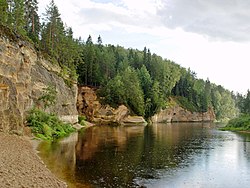
The Gauja River is a river in the Vidzeme region of Latvia. It is the only large river of Latvia that begins and ends its flow in Latvia. Its length is 460 km, of which 93.5 km are in Gauja National Park. In this part, the Gauja River flows through the Gauja Valley, which is between 1 and 2.5 km wide, and the maximum depth near Sigulda is 85 m. Thus, the Gauja is the longest river of Latvia if only the parts of the river in the country's territory are counted. The Daugava has only 367 km in Latvia, whereas the entire length of the river is over 1,000 km.
The sandstone rocks on the banks of the Gauja and its adjoining rivers started forming 370 to 300 million years ago, during the Devonian period.
5.1 km
Divezeri is a village in Ādaži Parish, Ādaži Municipality in the historical region of Vidzeme, and the Riga Planning Region in Latvia. The village is located on the shores of Lake Dūņezers, 8 km north of the municipal center of Ādaži.
Former Latvian Minister of Health Guntis Belēvičs is a developer based in the village.


6.0 km
Ādaži was established in 2004 as a protected landscape in the current Ādaži and Saulkrasti municipalities of Latvia. It is located within the Ādaži Military Polygon and its adjacent territories on the right banks of the lower part of the Gauja. The landscape is a Natura 2000 area.
The area was created to preserve Latvia's rare habitats created during military training - dry heaths and open inland dunes with sand dune meadows, bluish meadow meadows and mesotrophic lakes, as well as a significant number of specially protected plant and animal species. The area also includes the Lieluika and Mazuika Lakes nature reserve. Lake Mazuika is recognized as a benchmark for a clear water lake in the Baltic region.
Until 2019, economic activities in the area were governed by general rules on the use of specially protected areas, but special protection and use rules have been in force since 24 October 2019. In total 51 species of flora and fauna are protected under EU Nature directives.
