


Gauja Station is a railway station on the Zemitāni–Skulte Railway.
Location
1 explorer visited this place

957 m
Carnikava, previously Sānkaule, is a village and the center of the Carnikava Parish of Ādaži Municipality in the Vidzeme region of Latvia. It's located 25 km north from Riga at the mouth of the Gauja River. Carnikava had 4689 residents as of January 2020, making it the largest village by population in Latvia.
1.6 km
Carnikava Station is a railway station serving the village of Carnikava in Carnikava Parish, Ādaži Municipality, Vidzeme, Latvia. It is located on the Zemitāni–Skulte Railway. The train services to and from the station are operated by the national railway company Vivi which run frequent train services between Riga and Skulte.
The station was put into service on 26 October 1933 as the then-terminus stop of the line. The station building was unveiled in 1934 or 1935, and it was built, using parts of disassembled station buildings on the former Daugavpils–Rītupe Railway line.
The building features premises for railway personnel. The ticket office of the building was closed in 2025.
2.4 km
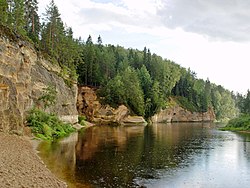
The Gauja River is a river in the Vidzeme region of Latvia. It is the only large river of Latvia that begins and ends its flow in Latvia. Its length is 460 km, of which 93.5 km are in Gauja National Park. In this part, the Gauja River flows through the Gauja Valley, which is between 1 and 2.5 km wide, and the maximum depth near Sigulda is 85 m. Thus, the Gauja is the longest river of Latvia if only the parts of the river in the country's territory are counted. The Daugava has only 367 km in Latvia, whereas the entire length of the river is over 1,000 km.
The sandstone rocks on the banks of the Gauja and its adjoining rivers started forming 370 to 300 million years ago, during the Devonian period.


4.1 km
Dabas parks Piejūra is a nature park along the Gulf of Riga in Latvia founded in 1962. It is a protected nature reserve and a Natura 2000 location. The park stretches 36.6 kilometres over an 4,180 hectares area from Riga, through Carnikava Municipality, and up to Saulkrasti. It is a popular seasonal recreation location, notably for beach access. The park is notable for its protected biotopes, particularly its dunes and boreal forests. The park's conservation plan for 2020 onwards was developed under the "LIFE CoHaBit" project.