

 English
 Français

Gowkhall
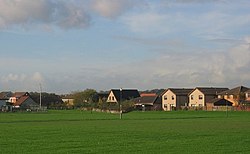
Gowkhall (for a period known as Balclune) is a hamlet in Fife Scotland, 3.6 miles (5.794 km) west of Dunfermline. The nearest village of size is Carnock 0.8 miles (1.287 km) to the west, which has a church and primary school. To the south there is the Dean Woods past which is the village of Crossford, which has two hotels and businesses.
Nearby Places View Menu

1.1 km
Carnock
Carnock (Scottish Gaelic: An Ceàrnach) is a village and parish of Fife, Scotland, 4+1⁄4 miles (7 kilometres) west of Dunfermline. It is 1+1⁄4 miles (2 kilometres) east of Oakley, Fife. The civil parish had a population of 5,927 as of 2011.
2.8 km
Crossford, Fife
Crossford is a small village located in West Fife, Scotland. Its population was 2,358 in 2011. It is 1 mile (1.6 kilometers) west of the city Dunfermline, east of Cairneyhill, astride the A994.
The village has mixed housing with large housing estates on the southwest and northwest ends. Most residents work either locally or commute to Edinburgh or Glasgow.
Crossford lies north of the Firth of Forth and 17 mi (27 km) from Edinburgh.
2.8 km
Cairneyhill
Cairneyhill is a village in West Fife, Scotland. It is 3 miles west of Dunfermline, on the A994, and has a population of around
2,510 (2020)
The village's architecture is a mix of old weavers' cottages and modern suburban housing estates. The village is located north and west of the A985, a major trunk road that provides fast travel by car or bus to the Kincardine Bridge, the M90 Motorway and the Queensferry Crossing/Forth Road Bridge. Cairneyhill lies to the north of Crombie.
The Firth of Forth is located 1.5 miles south of Cairneyhill, which is 1 mile (1.6 km) west of Crossford.

2.8 km
Oakley, Fife
Oakley is a village in Fife, Scotland located at the mutual border of Carnock and Culross parishes, Fife, 5+1⁄2 miles (9 kilometres) west of Dunfermline on the A907.
The village was built in connection with the Forth or Oakley Ironworks (1846), now all gone along with the colliery industry. The ironworks, which ceased production many years ago, had six furnaces, with stacks 180 feet (55 metres) high, and the engine-house was built with walls to comprise 60 cu ft (1.7 m3) of stone below the surface of the ground. Subsequent to their use in the ironworks, the buildings were used as a sawmill producing rough timber for railway sleepers, fence posts and the like. Comrie Colliery closed in 1986, and the village took many years to recover from this major employer's demise.