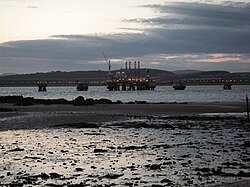
Hound Point is a marine terminal off a rocky headland of that name on the southern shore of the Firth of Forth, Scotland, just east of the Forth Bridge at South Queensferry. Opened in 1975, it is owned and operated by Ineos as an oil-export terminal for North Sea oil and is the largest such facility in Scotland. The terminal is made up of two sea-island berths that can load vessels of up to 350,000 DWT and a vapour recovery platform. Crude oil from the Forties pipeline undergoes stabilisation and gas processing and treatment at the Kinneil Terminal at Grangemouth before being pumped to a tank farm at Dalmeny on the southern shore of the Firth. The oil is then pumped to the Hound Point terminal where it is loaded onto tankers. The name 'Hound Point' derives from a local legend concerning the lord of nearby Barnbougle Castle, currently Lord Rosebery. The legend states that one of the first lords set off to fight in the Crusades, leaving his beloved hunting-hound behind. At the moment the man was killed, the hound began howling uncontrollably, eventually dying of its grief. Ever since, the howling ghost of the hound is said to appear on the Point whenever the present lord is about to die.

Nearby Places View Menu
Location Image
1.8 km

Inchgarvie

Inchgarvie or Inch Garvie is a small, uninhabited island in the Firth of Forth. On the rocks around the island sit four caissons that make up the foundations of the Forth Bridge. Inchgarvie's fortifications pre-date the modern period. In the days when boats were the only way to cross the Firth of Forth, the island was on the main route between North Queensferry in Fife and South Queensferry in Lothian. This made it strategically important. Although now uninhabited, Inchgarvie has been inhabited throughout various periods of history. The first recorded time was in the late 15th century. Like nearby Inchmickery, its profile and colour makes it look like a small warship from a distance. It was armed with coast defence guns from 1901 until 1906, and again from 1908 until the 1930s.
Location Image
1.9 km

Forth Bridge

The Forth Bridge is a cantilever railway bridge across the Firth of Forth in the east of Scotland, 9 miles (14 kilometres) west of central Edinburgh. Completed in 1890, it is considered a symbol of Scotland (having been voted Scotland's greatest man-made wonder in 2016), and is a UNESCO World Heritage Site. It was designed by English engineers Sir John Fowler and Sir Benjamin Baker. It is sometimes referred to as the Forth Rail Bridge (to distinguish it from the adjacent Forth Road Bridge), although this is not its official name. Construction of the bridge began in 1882 and it was opened on 4 March 1890 by the Duke of Rothesay, the future Edward VII. The bridge carries the Edinburgh–Aberdeen line across the Forth between the villages of South Queensferry and North Queensferry and has a total length of 2,467 metres (8,094 ft). When it opened it had the longest single cantilever bridge span in the world, until 1919 when the single 1,801 ft (549 m) span Quebec Bridge in Canada was completed. It continues to be the world's second-longest single cantilever span, with two spans of 1,709 feet (521 m). The bridge and its associated railway infrastructure are owned by Network Rail.
Location Image
2.0 km

Carlingnose Point Nature Reserve

Carlingnose Point Nature Reserve is a Site of Special Scientific Interest located in North Queensferry, Fife, Scotland.
Location Image
2.0 km

Deep Sea World

Deep Sea World is an aquarium located in the village of North Queensferry in Fife, Scotland. It is host to a collection of large sand tiger sharks, also known as ragged toothed sharks or grey nurse sharks, and various other species of shark.