

 English
 Français

Carrickstone
Carrickstone is an area of Cumbernauld, Scotland. It is on the north of the M80 and west of Cumbernauld Town Centre. The area it now occupies used to be covered by Carrickstone farm with the 25 inch Ordnance Survey map showing it between an ancient "standing stone" and The Village.
Nearby Places View Menu

427 m
Cumbernauld Village
Cumbernauld Village (often referred to locally as just the Village) is an area of Cumbernauld. Whilst Cumbernauld was designated a new town in 1955, the Village itself has a pre-mediaeval history, with a Roman settlement being built in the area due to its proximity to the Antonine Wall. After the Roman period the settlement remained and grew to such an extent that the Comyn family built their chapel there. It is recorded that, in 1500, the Black Death led to a special plea from the surviving people of Cumbernauld to the church authorities in Glasgow to allow them to establish their own cemetery rather than taking all their dead to St. Ninian's in Kirkintilloch. This source is also quoted in "Excavations at 3-11 Main Street, Cumbernauld". The villagers were granted permission to do so, and used the ground at the existing Comyns' chapel which dates from the end of the 12th century. Farming in long strips or Lang Riggs was carried out in the village.
The Flemings (who would become the Earls of Wigtown) later took over the Comyns' castle in Cumbernauld. In the 18th century this was replaced by Cumbernauld House
By the 17th century the main industry of the Village was hand loom weaving, but this subsequently changed as due to the village's proximity to the Forth and Clyde canal and rich source of natural minerals and stone it became a site of mining and quarrying. The Village was also the site of a number of tenant held farms on the Flemings' estate. The 19th century Groome's Gazetteer states that Cumbernauld is:
"A picturesque old place, sheltered to E and SE by the grounds of Cumbernauld House, it was created a burgh of barony in 1649, and has a post office under Glasgow, a branch of the Royal Bank, a local savings' bank, 2 chief inns, gas-works, many new handsome villas, and a cattle-fair on the second Thursday of May. The parish church here is an old building, containing 660 sittings; the Free church dates from 1826, having belonged to the Original Secession, but has been lately almost rebuilt; and there is also a new U.P. church. Handloom weaving of checks and other striped fabrics is still carried on, but mining and quarrying are the staple industry. Pop. (1861) 1561, (1871) 1193, (1881) 1064."
Cumbernauld had one of the oldest curling societies in the world which was established in the 18th century. The curling pond was near the Spur Inn, on the other side of the Bog Stank to the village.
October 1878 was a difficult time locally made worse by the failure of the Bank of Glasgow in which much of the village's money was invested. As the mining industry declined the village was further boosted by the decision to site a new town in the vicinity, with Cumbernauld lending its name to this new town.

529 m
Westerwood
Westerwood is an area in the north-east of Cumbernauld in North Lanarkshire, Scotland. Historically it was the site of a Roman Fort of which a video reconstruction has been produced. In the past two decades, new housing developments have been built around the Westerwood Hotel and Golf Course. The golf course, which was designed by Seve Ballesteros and Dave Thomas, is located on the north side of the town, close to Cumbernauld Airport. Westerwood Community Council was set up for local residents and a committee has been appointed. Neighbouring villages which are outside of Cumbernauld include Dullatur to the north-west and Castlecary to the east.
852 m
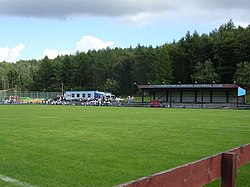
Cumbernauld United F.C.
Cumbernauld United Football Club are a football club based in Cumbernauld, North Lanarkshire, Scotland. They play at Guy's Meadow in the Cumbernauld Village area of the town.
Formed in 1964, they currently compete in the West of Scotland League First Division, having previously played in the SJFA West Region before moving to the senior pyramid in 2020.
Club colours are maroon and blue, and the club's nickname is "United".
The club has a full youth academy with teams from the under-6 age group up to under-19 level. The academy plays its home games on the 'HatTrix' astroturf park adjacent to the Guy's Meadow pitch, as well as on that pitch itself when weather permits.
The club also has a successful five a side complex and social club.
The team are managed by former Partick Thistle midfielder Andy Frame, who replaced previous manager George Shaw in January 2017.
1.4 km
Dullatur railway station
Dullatur railway station served the village of Dullatur, North Lanarkshire, Scotland from 1876 to 1967 on the Edinburgh and Glasgow Railway.