Location Image

Cumbernauld United F.C.

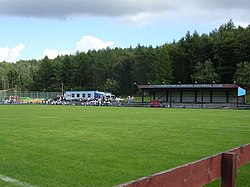
Cumbernauld United Football Club are a football club based in Cumbernauld, North Lanarkshire, Scotland. They play at Guy's Meadow in the Cumbernauld Village area of the town. Formed in 1964, they currently compete in the West of Scotland League First Division, having previously played in the SJFA West Region before moving to the senior pyramid in 2020. Club colours are maroon and blue, and the club's nickname is "United". The club has a full youth academy with teams from the under-6 age group up to under-19 level. The academy plays its home games on the 'HatTrix' astroturf park adjacent to the Guy's Meadow pitch, as well as on that pitch itself when weather permits. The club also has a successful five a side complex and social club. The team are managed by former Partick Thistle midfielder Andy Frame, who replaced previous manager George Shaw in January 2017.

Nearby Places View Menu
Location Image
638 m

Cumbernauld Village

Cumbernauld Village (often referred to locally as just the Village) is an area of Cumbernauld. Whilst Cumbernauld was designated a new town in 1955, the Village itself has a pre-mediaeval history, with a Roman settlement being built in the area due to its proximity to the Antonine Wall. After the Roman period the settlement remained and grew to such an extent that the Comyn family built their chapel there. It is recorded that, in 1500, the Black Death led to a special plea from the surviving people of Cumbernauld to the church authorities in Glasgow to allow them to establish their own cemetery rather than taking all their dead to St. Ninian's in Kirkintilloch. This source is also quoted in "Excavations at 3-11 Main Street, Cumbernauld". The villagers were granted permission to do so, and used the ground at the existing Comyns' chapel which dates from the end of the 12th century. Farming in long strips or Lang Riggs was carried out in the village. The Flemings (who would become the Earls of Wigtown) later took over the Comyns' castle in Cumbernauld. In the 18th century this was replaced by Cumbernauld House By the 17th century the main industry of the Village was hand loom weaving, but this subsequently changed as due to the village's proximity to the Forth and Clyde canal and rich source of natural minerals and stone it became a site of mining and quarrying. The Village was also the site of a number of tenant held farms on the Flemings' estate. The 19th century Groome's Gazetteer states that Cumbernauld is: "A picturesque old place, sheltered to E and SE by the grounds of Cumbernauld House, it was created a burgh of barony in 1649, and has a post office under Glasgow, a branch of the Royal Bank, a local savings' bank, 2 chief inns, gas-works, many new handsome villas, and a cattle-fair on the second Thursday of May. The parish church here is an old building, containing 660 sittings; the Free church dates from 1826, having belonged to the Original Secession, but has been lately almost rebuilt; and there is also a new U.P. church. Handloom weaving of checks and other striped fabrics is still carried on, but mining and quarrying are the staple industry. Pop. (1861) 1561, (1871) 1193, (1881) 1064." Cumbernauld had one of the oldest curling societies in the world which was established in the 18th century. The curling pond was near the Spur Inn, on the other side of the Bog Stank to the village. October 1878 was a difficult time locally made worse by the failure of the Bank of Glasgow in which much of the village's money was invested. As the mining industry declined the village was further boosted by the decision to site a new town in the vicinity, with Cumbernauld lending its name to this new town.
Location Image
852 m

Carrickstone

Carrickstone is an area of Cumbernauld, Scotland. It is on the north of the M80 and west of Cumbernauld Town Centre. The area it now occupies used to be covered by Carrickstone farm with the 25 inch Ordnance Survey map showing it between an ancient "standing stone" and The Village.
Location Image
942 m

Kildrum

Kildrum was the first area to be constructed in Cumbernauld new town, North Lanarkshire, Scotland. It provided housing for the workers at the Burroughs factory at Old Inns, the first factory in Cumbernauld New Town. The main road is in the shape of an arc with residential streets leading from it. Inside the arc are ex-corporation houses and there is better quality, mostly private, housing on the outside. The street names of Kildrum are taken from places associated with Robert Burns. Facilities include Cumbernauld Academy, Kildrum primary school, Kildrum family learning centre, Redburn ASN School, health centre/dentist, YMCA, three shops, chemist, two churches/chapels, Salvation Army and the new Cumbernauld theatre ( Red Lantern Theatre) Kildrum's history did not begin with the new town since as far back as 1 October 1310 Robert the Bruce wrote to Edward II of England from Kildrum trying, unsuccessfully, to establish peace between Scotland and England. There was also a farm about which some records exist. The Town Centre and Carbrain lie to the west of Kildrum. To the north is Seafar, to the east Cumbernauld Park and to the south Cumbernauld Glen.
Location Image
977 m

Seafar

Seafar is an area of the town of Cumbernauld. The original Seafar sand pit and farm were in the middle of what is now the A8011. Early in the new town's history Seafar was more distinct from Ravenswood and Muirhead than it now is possibly due to the building schedule and signage on paths. Recently Seafar is more dominant, perhaps because neither Ravenswood nor Muirhead appear on road signs. Seafar is south of the M80 motorway and is bordered by Seafar wood, planted at the time of the construction of the town. The area was the second built in the new town of Cumbernauld, its many streets are named after famous Scottish artists and writers. St Mary's is its local Roman Catholic primary school. Seafar Primary School was demolished and replaced by sheltered housing in 2004. There is a Kingdom Hall of Jehovah's Witnesses next to St Mary's Primary school. The demolition of multistorey flats gave rise to a new housing development by Sanctuary Homes. Over a hundred new houses in Berryhill Road and Hume Road are due for completion in March 2018.