

 English
 Français

Carlisle Tithe Barn
Carlisle Tithe Barn is an historic building in Carlisle, Cumbria. It is a Grade I listed building, listed on 1 June 1949.
Nearby Places View Menu
104 m
Carlisle Dominican Friary
Carlisle Dominican Friary was a friary in Cumbria, England. The Dominican order settled in Carlisle in 1233. The convent of the Black Friars, as this was known, was located between what was later the St. Cuthberts's church and the English gate. Later archeological findings show that the convent was built over an earlier Roman settlement.
The friary was dissolved along with other religious houses in the spring of 1539 by Richard, Bishop of Dover. Unlike other houses the buildings were retained and converted to a council chamber and storehouse. None of these remain in the present city of Carlisle.

125 m
Carlisle city walls
Carlisle city walls were a defensive structure surrounding the centre of Carlisle, Cumbria. The city walls ran from Carlisle Castle in the north-west of the city to The Citadel in the south-east. Between these points, the city was protected by the former North and East Walls (demolished around 1811) and the West Walls which remain largely intact. The line of the walls can still be followed with the exception of the southernmost end of the West Wall which has been built over. The perimeter, including the castle, is approximately 2.2 kilometres (1.4 mi) which is comparable to Southampton town walls but less than Chester city walls.

168 m
Diocese of Carlisle
The Diocese of Carlisle was created in 11 April 1132 by Henry I out of part of the Diocese of Durham, although many people of Cumbric descent in the area looked to Glasgow for spiritual leadership. The first bishop was Æthelwold, who was the king's confessor and became prior of the Augustinian priory at Nostell in Yorkshire. Carlisle was thus the only cathedral in England apart from Bristol to be run by Augustinians instead of Benedictines. This only lasted until the reign of Henry III however, when the Augustinians in Carlisle joined the rebels who temporarily handed the city over to Scotland and elected their own bishop. When the revolt was ended, the Augustinians were expelled.
The seat of the diocese is the Cathedral Church of the Holy and Undivided Trinity in Carlisle.
The Diocese covers most of the ceremonial county of Cumbria; Alston Moor is part of the Diocese of Newcastle. The diocese originally only covered the northern parts of Cumberland and Westmorland, and expanded to cover almost the entirety of these, as well as the Furness and Cartmel areas of Lancashire, in 1847, from part of the Diocese of Chester, although this did not take effect until 1856.
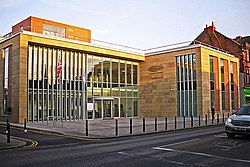
172 m
Cumberland (unitary authority)
Cumberland is a unitary authority area in the ceremonial county of Cumbria, England. It covers the north-western part of Cumbria, including the west of the Lake District. The city of Carlisle is the largest settlement and the administrative centre. The unitary authority area covers the majority of the area of the historic county of Cumberland, from which it takes its name, but does not include the area around Penrith.
The unitary authority area was formed on 1 April 2023 during a local government restructuring which abolished the non-metropolitan county of Cumbria and its six districts. Cumberland has the same area as the former districts of Carlisle, Allerdale, and Copeland, being constituted as a non-metropolitan county and coterminous non-metropolitan district with the same area as the former districts. The three remaining districts of Cumbria were merged into Westmorland and Furness. It remains part of Cumbria for ceremonial purposes. Prior to the local government reforms of 1974, which created Cumbria, Carlisle was a county borough and the remainder of the area was within the administrative county of Cumberland.
The local authority for the area is Cumberland Council, which provides the services of both a county council and a district council. The first elections to the new authority took place in May 2022, with Cumberland Council acting as a "shadow authority" until the abolition of Cumbria County Council and the three district councils on 1 April 2023.