Location Image

Cumberland (unitary authority)

Cumberland is a unitary authority area in the ceremonial county of Cumbria, England. It covers the north-western part of Cumbria, including the west of the Lake District. The city of Carlisle is the largest settlement and the administrative centre. The unitary authority area covers the majority of the area of the historic county of Cumberland, from which it takes its name, but does not include the area around Penrith. The unitary authority area was formed on 1 April 2023 during a local government restructuring which abolished the non-metropolitan county of Cumbria and its six districts. Cumberland has the same area as the former districts of Carlisle, Allerdale, and Copeland, being constituted as a non-metropolitan county and coterminous non-metropolitan district with the same area as the former districts. The three remaining districts of Cumbria were merged into Westmorland and Furness. It remains part of Cumbria for ceremonial purposes. Prior to the local government reforms of 1974, which created Cumbria, Carlisle was a county borough and the remainder of the area was within the administrative county of Cumberland. The local authority for the area is Cumberland Council, which provides the services of both a county council and a district council. The first elections to the new authority took place in May 2022, with Cumberland Council acting as a "shadow authority" until the abolition of Cumbria County Council and the three district councils on 1 April 2023.

Nearby Places View Menu
Location Image
0 m

Carlisle

Carlisle ( kar-LYLE, locally KAR-lyle; from Cumbric: Caer Luel) is a city located in the Cumberland district of Cumbria, England. It is the largest settlement and only city in Cumbria. In 2021 it had a population of 77,730. Carlisle's early history is marked by the establishment of a settlement called Luguvalium to serve forts along Hadrian's Wall in Roman Britain. Nicknamed the 'Great Border City' due to its proximity to Scotland (being located eight miles or thirteen kilometres south of the current Anglo-Scottish border), the city and Carlisle Castle became an important military stronghold in the Middle Ages. The castle served as a prison for Mary, Queen of Scots in 1568 and currently hosts the Duke of Lancaster's Regiment and the Border Regiment Museum. A priory was built in the early 12th century, which subsequently became Carlisle Cathedral in 1133 on the creation of the Diocese of Carlisle. As the seat of a diocese, Carlisle therefore gained city status. Carlisle also served as the county town of the historic county of Cumberland from the county's creation in the 12th century. In the 19th century, the introduction of textile manufacture during the Industrial Revolution began a process of socioeconomic transformation in Carlisle, which developed into a densely populated mill town. This, combined with its strategic position, allowed for the development of Carlisle as an important railway town, with seven railway companies sharing Carlisle railway station.
Location Image
19 m

Carlisle Guildhall

Carlisle Guildhall is an historic building in Carlisle, Cumbria. It is in the city centre, on the corner of Fisher Street and Greenmarket. It is a Grade I listed building, listed on 1 June 1949. The upper floors now house a museum.
Location Image
39 m

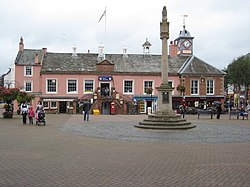
Old Town Hall, Carlisle

The Old Town Hall is a municipal building in the Market Place, Carlisle, England. It is a Grade I listed building.
50 m

Luguvalium

Luguvalium (or Luguvalium Carvetiorum) was an ancient Roman city in northern Britain located within present-day Carlisle, Cumbria, and may have been the capital of the 4th-century province of Valentia. It was the northernmost city of the Roman Empire.