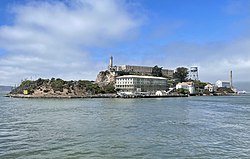
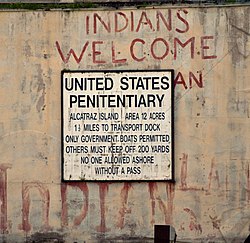
United States Penitentiary, Alcatraz Island, also known simply as Alcatraz (English: , Spanish: [alkaˈtɾas] "the gannet") or The Rock, was a maximum security federal prison on Alcatraz Island, 1.25 miles (2.01 km) off the coast of San Francisco, California, United States. The site of a fort since the 1850s, the main prison building was built from 1910 to 1912 as a U.S. Army military prison. The United States Department of Justice acquired the United States Disciplinary Barracks, Pacific Branch, on Alcatraz on October 12, 1933. The island became adapted and used as a prison of the Federal Bureau of Prisons in August 1934 after the buildings were modernized and security increased. Given this high security and the island's location in the cold waters and strong currents of San Francisco Bay, prison operators believed Alcatraz to be escape-proof and America's most secure prison. The three-story cellhouse included the four main cell blocks – A-block through D-block – the warden's office, visitation room, the library, and the barber shop. The prison cells typically measured 9 feet (2.7 m) by 5 ft (1.5 m) and 7 ft (2.1 m) high. The cells were primitive and lacked privacy. They were furnished with a bed, desk, washbasin, a toilet on the back wall, and few items other than a blanket. Black inmates were segregated from other inmates. D-Block housed the worst inmates, and six cells at its end were designated "The Hole". Prisoners with behavioral problems were sent to these for periods of often brutal punishment. The dining hall and kitchen extended from the main building. Prisoners and staff ate three meals a day together. The Alcatraz Hospital was located above the dining hall. Prison corridors were named after major U.S. streets, such as Broadway and Michigan Avenue, of New York City and Chicago, respectively. Working at the prison was considered a privilege for inmates. Those who earned privileges were employed in the Model Industries Building and New Industries Building during the day, actively involved in providing for the military in jobs such as sewing and woodwork, and performing various maintenance and laundry chores. The prison closed in 1963, but Alcatraz was reopened as a public museum. The island and prison were occupied by Native Americans from 1969 to 1971. It is one of San Francisco's major tourist attractions, attracting some 1.5 million visitors annually. Now operated by the National Park Service's Golden Gate National Recreation Area, the former prison is being restored and maintained.

Nearby Places View Menu
Location Image
24 m

Fort Alcatraz

Fort Alcatraz was a United States Army coastal fortification on Alcatraz Island near the mouth of San Francisco Bay in California, part of the Third System of fixed fortifications, although very different from most other Third System works. Initially completed in 1859, it was also used for mustering and training recruits and new units for the Civil War from 1861 and began secondary use as a long-term military prison in 1868. Major improvements, needed because of changes in artillery, began in the 1870s, but were underfunded and never fully completed, as the post came to be seen less as defense and more as a jail. The site was not used for any major works of the Endicott Board’s plan for the defense of the Bay. A large concrete prison block was erected between 1910 and 1912. In 1933–1934, this was modernized and became the Alcatraz Federal Penitentiary.
Location Image
24 m

June 1962 Alcatraz escape

On the night of June 11, 1962, inmates Frank Morris and brothers John and Clarence Anglin escaped from Alcatraz Federal Penitentiary, the maximum-security prison on Alcatraz Island in San Francisco Bay, California, United States. Having spent six months preparing their breakout, the three men tucked papier-mâché model heads resembling their own likenesses into their beds, broke out of the main prison building via ventilation ducts and an unguarded utility corridor, and departed the island aboard an improvised inflatable raft to an uncertain fate. A fourth inmate, Allen West, failed to escape with Morris and the Anglins and was left behind. Hundreds of leads were pursued by the Federal Bureau of Investigation (FBI) and local law enforcement officials in the ensuing years, but no conclusive evidence has ever surfaced regarding the fate of Morris and the Anglins. In 1979, the FBI officially concluded, on the basis of circumstantial evidence and a preponderance of expert opinion, that the three inmates likely drowned in the frigid waters of San Francisco Bay while attempting to reach the mainland. The U.S. Marshals Service case file remains open and active, and Morris and the Anglin brothers will remain on its wanted list until September 2026. Numerous theories of widely varying plausibility on the fates of the three fugitives have been proposed by authorities, reporters, family members, and amateur enthusiasts, with circumstantial and material evidence continuing to surface, stoking debates as to whether the inmates may have survived their escape.
Location Image
24 m

Alcatraz Island

Alcatraz Island () is a small island about 1.25 miles offshore from San Francisco in San Francisco Bay, California, near the Golden Gate Strait. The island was developed in the mid-19th century with facilities for a lighthouse, a military fortification, and a military prison. In 1934, the island was converted into a federal prison, Alcatraz Federal Penitentiary. The strong tidal currents around the island and ice-cold water temperatures made escape nearly impossible, giving the prison one of the most notorious reputations of its kind in American history. The prison closed on March 21, 1963, leaving the island a major tourist attraction today with nearly 1.4 million people visiting the island annually. Beginning in November 1969, the island was occupied for more than 19 months by a group of Native Americans, initially primarily from San Francisco, who were later joined by the American Indian Movement and other urban Native Americans from other parts of the country, who were part of a wave of Native American activists organizing public protests across the US through the 1970s. In 1972, Alcatraz was transferred to the Department of Interior to become part of Golden Gate National Recreation Area. It was designated as a National Historic Landmark in 1986. Today, the island's facilities are managed by the National Park Service as part of Golden Gate National Recreation Area. Visitors can reach the island by ferry ride from Pier 33, located between the San Francisco Ferry Building and Fisherman's Wharf. Hornblower Cruises, operating under the name Alcatraz City Cruises, is the official ferry provider to and from the island. Alcatraz Island is the site of the abandoned federal prison, the oldest operating lighthouse on the West Coast of the United States, early military fortifications, and natural features such as rock pools and a seabird colony (mostly western gulls, cormorants, and egrets). According to a 1971 documentary on the history of Alcatraz, the island measures 1,675 feet (511 m) by 590 feet (180 m) and is 135 feet (41 m) at highest point during mean tide. The total area of the island is reported to be 22 acres (8.9 ha). Landmarks on the island include the Main Cellhouse, Dining Hall, Lighthouse, the ruins of the Warden's House and Social Hall, Parade Grounds, Building 64, Water Tower, New Industries Building, Model Industries Building, and the Recreation Yard.
Location Image
24 m

Occupation of Alcatraz

The Occupation of Alcatraz (November 20, 1969 – June 11, 1971) was a 19-month long occupation of Alcatraz Island and its prison complex, then classified as abandoned surplus federal land, by 89 American Indians and their supporters. The occupation was led by Richard Oakes, LaNada Means, and others, while John Trudell served as spokesman. The group lived on the island together until the occupation was forcibly ended by the U.S. government. The protest group chose the name Indians of All Tribes (IAT) for themselves. IAT claimed that, under the Treaty of Fort Laramie (1868) between the U.S. and the Lakota tribe, all retired, abandoned, or out-of-use federal land was to be returned to the Indigenous peoples who once occupied it. As Alcatraz penitentiary had been closed on March 21, 1963, and the island had been declared surplus federal property in 1964, a number of Red Power activists felt that the island qualified for a reclamation by American Indians. The Occupation of Alcatraz had a brief effect on federal Indian Termination policies and established a precedent for American Indian activism. Oakes was later shot to death in 1972. The American Indian Movement was targeted by the federal government and FBI in COINTELPRO and similar surveillance operations.