

 English
 Français

Old Malton
Old Malton is a village in the civil parish of Malton, in North Yorkshire, England. The village is situated just south of the A64 road and is 1-mile (1.5 km) north-east of the town of Malton. The village is on the B1257 which links Malton with the A64 and the A169 road to the north and is bounded on its eastern side by the River Derwent.
Nearby Places View Menu

292 m
Malton Priory
Malton Priory, Old Malton, North Yorkshire, England, is near to the town of Malton. It was founded as a monastery of the Gilbertine Order by Eustace fitz John, the lord of Malton Castle. Fitz John founded both Malton Priory and Watton Priory around 1150; some sources suggest that this was an act of penance for his support for the Scots in the Battle of the Standard.
The prior was accused of taking part in the Pilgrimage of Grace.
After the Dissolution, the site was bought in 1540 by Robert Holgate, the former master of the Gilbertine Order, who was then Bishop of Llandaff. In 1545 Holgate became Archbishop of York. He founded three grammar schools in Yorkshire, including Malton School (on part of the monastic site).

334 m
Old Abbey, Malton
The Old Abbey, also known as Abbey House, is a historic building in Old Malton, a village in North Yorkshire, in England.
The building lies on part of the site of Malton Priory. Most of the priory was demolished following the Dissolution of the Monasteries, but the undercroft of the refectory survived. In the late 17th century, a house was constructed, using the undercroft as its basement. It was altered and extended in the late 18th century, the work including a new stable block. It was again altered and extended in the late 19th century, and in the 20th century. The building was grade II* listed in 1951. In 1988, it was converted into a residential care home for the elderly.
The original part of the house is built of sandstone, partly on a chamfered plinth, the rear wing is in orange-red brick, and the roofs are in pantile with a stone slate verge, coped gables, moulded kneelers, and ball and pedestal finials. It has two storeys and an attic, four bays, two-storey one-bay cross-wings, and rear wings. On the front is a doorway with a fanlight, a coved string course, and moulded eaves. Most of the windows are sashes, and there are two gabled dormers. The outbuildings include a stable block with one storey and an attic and four bays. It contains a segmental-arched opening, doorways and sash windows. Inside, there is an early staircase, the original kitchen fireplace, and several round-arched ovens. The undercroft is vaulted and has a stone bench on the west side, a mullioned window, former fireplace, and blocked tunnel.
714 m
Eden Camp Museum
Eden Camp Modern History Museum is a large Second World War-related museum near Malton in North Yorkshire in England.
It occupies a former Second World War prisoner-of-war camp of 33 huts. After the prisoners left, the camp was used for storage and then abandoned. Its grounds then became overgrown. As the museum was being set up, much clearing, as well as repair and renovation of the buildings, was required.
One of its buildings contains three human torpedoes and a "Sleeping Beauty" Motorised Submersible Canoe.The museum has fully restored a Super Sherman (M50) to its original working classic, amongst many other military vehicles which are now on display in the Heritage Hall - a new purpose built events and exhibition centre.
The museum also has a reproduction V1.
1.0 km
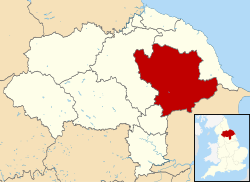
Ryedale District
Ryedale was a non-metropolitan district in North Yorkshire, England. It was in the Vale of Pickering, a low-lying flat area of land drained by the River Derwent. The Vale's landscape is rural with scattered villages and towns. It has been inhabited continuously from the Mesolithic period. The economy was largely agricultural with light industry and tourism playing an increasing role.
Towns included Helmsley, Kirkbymoorside, Malton, Norton-on-Derwent, and Pickering. Part of Ryedale lies within the North York Moors National Park. The A64 passed through Ryedale and villages such as Rillington. In the 2011 Census, the population of this primarily rural area of 150,659 hectares, the largest district in North Yorkshire, was 51,700.