

 English
 Français

St Mary the Virgin's Church, Middleton
The Church of St Mary the Virgin in Middleton, West Yorkshire, England is an active Anglican parish church in the Armley deanery in the archdeaconry of Leeds and the Diocese of Leeds. The church and its lych gate are Grade II listed buildings.
Nearby Places View Menu
646 m
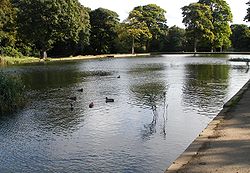
Middleton Park
Middleton Park is a public park in Middleton, Leeds, West Yorkshire, England. It covers an area of 630 acres (255.0 ha), nearly a square mile of which 200 acres (80.9 ha) are ancient woodland. There is also a small lake, recreational areas and a former golf course. The reclaimed site of "Middleton Broom" Colliery has been incorporated into the park. By its northern boundary is the South Leeds Stadium, home of rugby league club Hunslet. The Middleton Railway runs between Moor Road, Hunslet and Park Halt railway station. It is also the site of Leeds Urban Bike Park. It is known locally as 'Miggy Park'.

965 m
St Cross Church, Middleton
The Church of St Cross is in Middleton, Leeds, West Yorkshire, England. It is an active Anglican church and part of the Armley deanery in the archdeaconry of Leeds, Diocese of Leeds.

1.1 km
Park Halt railway station
Park Halt railway station on the Middleton Railway in Leeds, West Yorkshire, England is the terminal station of the railway. It is situated next to Middleton Park. The halt was constructed so passengers could alight to walk around the reclaimed colliery site of Broom Pit and allow for the run-round of trains.
Park Halt is located near the John Charles Centre for Sport. The site consists of a platform with pedestrian access into the park.

1.2 km
Middleton, Leeds
Middleton is a largely residential suburb of Leeds in West Yorkshire, England and historically a village in the West Riding of Yorkshire. It is situated on a hill 4 miles (6 km) south of Leeds city centre and 165 miles (266 km) north north-west of London.
It sits in the Middleton Park ward of Leeds City Council and Leeds South parliamentary constituency. The population of Middleton Park ward - which includes Belle Isle - was 31,472 at the 2020 Census.
Middleton was occupied before the Norman Conquest and recorded in the Domesday Book of 1086 as Mildetone. It developed as a manorial estate and its owners began to exploit the coal seams that outcropped within its boundaries. At the start of the Industrial Revolution a wooden wagonway was built to link the coal pits to Leeds. The colliery agent, John Blenkinsop designed an iron railway and its first steam-powered locomotive which was built by Matthew Murray in Holbeck. The coal mines on which the local economy was based lasted until 1968 and the railway is preserved and run by a trust after operating for 200 years.
Middleton Park, a remnant of the manorial estate, contains a large area of ancient woodland and parts of it, where coal was mined, are designated a scheduled ancient monument. It was the location of Middleton Hall and Middleton Lodge, homes to the local gentry.
The village developed along Town Street, a school, chapel and church were built in the 19th century but after the land was acquired by Leeds Council in 1920 a large council housing estate was built on the flatter land to the south, completely changing the rural nature of the settlement. Early transport was provided by a tram line and the Leeds Ring Road was built to Middleton. After the colliery closed the area began to decline and by 2001, had areas of multiple deprivation and high levels of unemployment and anti-social behaviour. The Middleton Regeneration Board has been established with the remit of addressing these issues.