

 English
 Français

Casque de Ribchester
Le casque de Ribchester est un casque romain de la fin du Ier siècle ou du début du IIe siècle découvert en 1796 par le fils d'un sabotier de Ribchester, dans le Nord-Ouest de l'Angleterre. Il est exposé au British Museum, à Londres. Il s'agit d'un casque de parade en bronze avec un masque facial complet. Il était vraisemblablement coiffé d'une figurine de sphinx découverte en même temps, mais perdue par la suite. Sa conception élaborée suggère qu'il n'était pas conçu pour être porté au combat, mais lors des hippika gymnasia, des tournois de cavalerie décrits par Arrien.
Nearby Places View Menu

67 m
Bremetennacum
Bremetennacum, ([brɛmɛˈteːnːakʊm]), or Bremetennacum Veteranorum, was a Roman fort on the site of the present day village of Ribchester in Lancashire, England (grid reference SD650350). (Misspellings in ancient geographical texts include Bremetonnacum, Bremetenracum or Bresnetenacum.) The site is a Scheduled Monument.
The site guarded a crossing-point of the River Ribble. The first known Roman activity was the building of a timber fort, believed to have been constructed during the campaigns of Petillius Cerialis around AD 72/3. This was replaced by a stone fort in the 2nd century. For most of its existence the fort was garrisoned by Sarmatian auxiliaries, first stationed in Britain by Marcus Aurelius in 175. Prior to that it is suggested that the fort was garrisoned by the Ala II Asturum from Spain, but there is some uncertainty about this. Pottery evidence indicates that the fort was occupied for most of the 4th century until the end of the Roman period.

174 m
Ribchester Roman Museum
Ribchester Roman Museum (officially the Ribchester Roman Museum of Roman Antiquities) is located in the village of Ribchester, Lancashire, England. It sits at the southern end of Church Street, near the northern banks of the River Ribble, adjacent to St Wilfrid's Church. Founded in 1915 by Margaret Greenall, a member of Warrington's Greenall's brewing family, it is registered charity number 510490 with the UK Charity Commission.
The museum houses many of the finds from Bremetennacum, the Roman fort a few yards away. The most notable find, the Ribchester Helmet, is on show in replica; the original is in the British Museum collection.
The museum's former honorary curator, Jim Ridge, had a gallery at the museum named in his honour after his death in 2003. Ridge instigated a Time Team dig in Ribchester in September 1993 after writing to them regarding remnants of the Roman fort being in the back garden of his 2 Church Street cottage.

175 m
Stydd Brook
Stydd Brook is a watercourse in Lancashire, England.
Rising on Gannow Fell, south west of the Forest of Bowland, the river flows southward, meeting the River Ribble at Ribchester.
Stydd Brook flows by Black Plantation then between Moor Nook Farm and Davies Gate, before moving through Stydd Wood.
181 m
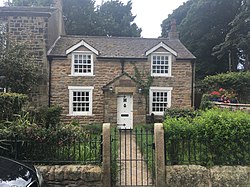
2 Church Street, Ribchester
2 Church Street is a building in Ribchester, Lancashire, England. The property dates to at least the 19th century. In the 1970s, it was discovered that the northeastern corner of a Roman fort, centred in the immediate area, is located on the property. The fort, named Bremetennacum Veteranorum, is now a scheduled monument. A sod-and-clay rampart had existed before the fort was constructed.
The rear of the property was originally partially excavated during the 1970s, when a cobblestoned surface and a stone corner watchtower were discovered; it was then covered with a plastic sheet in an attempt to preserve them.

213 m
St Wilfrid's Church, Ribchester
St Wilfrid's Church is an Anglican church in the village of Ribchester in Lancashire, England, which is situated close to the site of a Roman fort. It is an active parish church in the Diocese of Blackburn. It is recorded in the National Heritage List for England as a designated Grade I listed building.