

 English
 Français
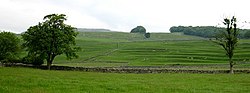
Austwick
Austwick is a village and civil parish in North Yorkshire, England, about 5 miles (8 km) north-west of Settle. The village is on the edge of the Yorkshire Dales National Park. Before local government reorganisation in 1974, Austwick parish was within Settle Rural District which was in the county of the West Riding of Yorkshire. From 1974 to 2023 it was part of the district of Craven, it is now administered by the unitary North Yorkshire Council. According to the Austwick & Lawkland Tithe Map of 21 October 1851 the parish has an area of 8,201 acres (33.19 km2) of which around a quarter is uncut moorland. The highest point within the parish is at Lord's Seat on Simon Fell at 2,079 feet (634 m).
Nearby Places View Menu

124 m
Church of the Epiphany, Austwick
The Church of the Epiphany is the parish church of Austwick, a village in North Yorkshire, in England.
The church was funded by Charles and E. A. Ingleby, and was constructed between 1839 and 1840. It was consecrated in 1841. A chancel was added in 1883, and stained glass designed by Lavers and Westlake was inserted between 1880 and 1890. The rose window was replaced in 1990. In 2017, the baptistry was converted into a kitchen, and the former bier house was demolished and replaced by toilets. The church was grade II listed in 1988.
The church is built of rubble, with stone dressings, and a slate roof. It consists of a four-bay nave, an apsidal chancel, a western baptistry, a south porch, and a north vestry. The windows are lancets, while the entrance has a Tudor arch. There is a bellcote at the western end, with a ball finial. There is a king post roof. Inside, the pews are made of wood from Lawkland Wood, and some have racks designed for top hats beneath them.

389 m
Austwick Hall
Austwick Hall is an historic manor house situated above the village of Austwick in North Yorkshire, England. The house is a Grade II listed building and contains a collection of furniture, paintings and ethnographic art. The gardens and woodland also contain a collection of contemporary sculptures. Austwick Hall is open to the public from the beginning of April to the end of October and takes guests for bed and breakfast throughout the year.

1.3 km
Norber erratics
The Norber erratics are a group of glacial erratic boulders in Britain. They are found on the southern slopes of Ingleborough, close to the village of Austwick in the Yorkshire Dales. The Ordnance Survey grid reference of the boulder field is SD764698.
The erratics are classic geomorphological features from the glaciation of northern England. In his chapter on the Pennines, A. E. Trueman wrote: "Particularly well known are the great perched blocks of dark grit which stand on the limestone platform at Norber near Settle."
Many of the Silurian greywacke boulders at the site are perched on pedestals of limestone up to 30cm high. The boulders were probably deposited by melting ice sheets at the end of the last ice age, around 12,000 years ago. The pedestals have developed because the erratic boulders have protected the underlying limestone from solution by rainfall, giving estimates of the rate of lowering of the surrounding limestone pavement of around 25mm per 1000 years. Recent cosmogenic dating suggests that the boulders have been exposed for around 17,900 years.

1.6 km
Oxenber and Wharfe Woods
Oxenber and Wharfe Woods is a Site of Special Scientific Interest (SSSI) within Yorkshire Dales National Park in North Yorkshire, England. It is located 550 yards (500 m) north-west of the hamlet of Feizor. This area is protected because of the plant diversity found across the habitats present that include woodland, grassland and limestone pavement. Grazing has led to the woodland being classified as wood-pasture. This protected area comprises three named woodlands: Oxenber Wood, Wharfe Wood and Feizor Wood.
Plant species within the woodland habitats vary between different soil types present in this protected area. On limestone soils, tree species include ash, hazel, hawthorn and rowan; and herbaceous plant species include dog's mercury, wood sorrel, wild thyme, salad burnet and spurge laurel. On acidic soils, tree species include birch and holly and understorey plant species include bilberry, wood anemone and heath bedstraw. Plant species within the limestone pavement include lesser meadow-rue, northern bedstraw and bloody cranes-bill.
Within the northern section of Wharfe Wood there is marsh habitat where plant species include marsh marigold, bog asphodel, marsh arrowgrass and marsh valerian.