


La Base chaude opérationnelle du Tricastin (BCOT) est une installation nucléaire située sur le site nucléaire du Tricastin spécialisée dans la maintenance nucléaire. Elle entretient et entrepose des matériels et outillages provenant des circuits et matériels contaminés des réacteurs électronucléaires, à l'exclusion d'éléments combustibles, et notamment les tubes guides, les outillages d'intervention, les matériels voués au démantèlement et les couvercles de cuve.
Location
1 explorer visited this place
962 m
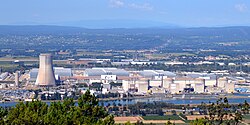
The Tricastin Nuclear Power Plant is a nuclear power plant consisting of 4 pressurized water reactors of CP1 type with 915 MW electrical power output each. The power plant is located in the south of France at the Canal de Donzère-Mondragon near the Donzère-Mondragon Dam and the commune Pierrelatte.
The power plant is part of the widespread Tricastin Nuclear Site, which was named after the historic Tricastin region. Three out of the four reactors on the site had been used until 2012 to power the Eurodif Uranium enrichment plant, which had been located on the site.

1.1 km
Eurodif, which means European Gaseous Diffusion Uranium Enrichment Consortium, is a subsidiary of the French company Orano, which operates a uranium enrichment plant, called the Georges-Besse plant, established at the Tricastin Nuclear Power Center in Pierrelatte in Drôme. The nuclear site of Pierrelatte includes many nuclear installations, of which the largest are the Eurodif fuel factory and the Tricastin nuclear power station.
Enriched uranium is the preferred fuel for light water reactors, a common nuclear power technology.
1.1 km
The Georges-Besse plant, known as the Eurodif plant from 1978 to 1988, was a nuclear facility specializing in uranium enrichment by gaseous diffusion. The plant, now in the nuclear dismantling phase, is located on the Tricastin nuclear site at Pierrelatte in the Drôme region.
On the initiative of French President Georges Pompidou in late 1969, an agreement was signed between France, Belgium, Italy, and Spain in 1972 to give France complete autonomy over the nuclear fuel cycle. The plant was inaugurated in 1979 and operated for 33 years by Eurodif SA, a subsidiary of Areva NC. Along with Urenco, which operates based on an agreement between Germany, the UK, and the Netherlands, it was the only uranium enrichment plant operating based on a multinational agreement.
The Tricastin nuclear site comprises several nuclear facilities, the largest of which are the Tricastin nuclear power plant, the former Georges-Besse plant, and the new Georges-Besse II centrifuge enrichment plant.
The enriched uranium produced was used as fuel by French nuclear power plants and many foreign power plants. The enriched uranium produced by this plant supplied around 90 pressurized water reactors, the most widely used nuclear technology in the world, including the 58 French reactors. Eurodif SA's customers included EDF and over 30 electricity companies worldwide, and its main competitors were the United States and Russia.

1.6 km
The Tricastin Nuclear Site is an industrial site that encompasses facilities of the nuclear fuel cycle and a nuclear power plant. It is located in France, in the lower Rhône valley, at the heart of the historic Tricastin region, on the right bank of the Canal de Donzère-Mondragon between Valence upstream) and Avignon downstream). It covers an area of 600 hectares, spread across four communes: Saint-Paul-Trois-Châteaux and Pierrelatte in Drôme, and Bollène and Lapalud in Vaucluse. The nuclear power plant has been subject to several reported incidents and was placed under "enhanced surveillance" in 2017.
2.3 km
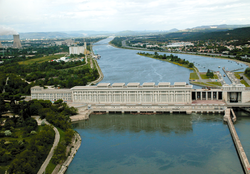
The Donzère-Mondragon Dam, located in the French commune of Bollène-Écluse is a hydroelectric dam and lock built in 1952 at the southern end of the Donzère-Mondragon canal, in the Vaucluse department in France. It was registered in the list of historic monuments in France in 1992.