

 English
 Français
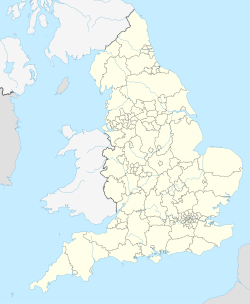
Rawmarsh
Rawmarsh est une localité anglaise du district métropolitain de Rotherham dans le Yorkshire du Sud.
Nearby Places View Menu

0 m
Rawmarsh
Rawmarsh (locally ) is a village in the Metropolitan Borough of Rotherham, in South Yorkshire, England. Historically within the West Riding of Yorkshire, it is 2 miles (3 km) north-northeast from Rotherham town centre and 3 miles (5 km) south-southwest of Swinton. The village also forms part of the Sheffield Urban Area. The Rawmarsh ward of Rotherham MBC had a population of 13,389 at the 2011 Census. Rawmarsh also contains other output areas from neighbouring wards giving it a population of 18,498 in 2011 and 18,535 in 2014.

401 m
Rawmarsh Community School
Rawmarsh Community School is a coeducational secondary school with academy status located in Rotherham, South Yorkshire, England.

868 m
Parkgate F.C.
Parkgate Football Club is an English football club based in Parkgate, Rotherham, South Yorkshire. They play in the Northern Counties East Football League Division One, at level 10 of the English football league system.
957 m
New Stubbin Colliery
New Stubbin Colliery was a coal mine situated in the township of Rawmarsh near Rotherham, South Yorkshire, England. The colliery was situated in a deep valley. Along one side at the top of the valley runs Haugh Road, Rawmarsh and on the other a lane known locally as "Greasbrough Tops".
The first sod of the new colliery development was cut by Viscount Milton, son of Earl Fitzwilliam, on 14 November 1913 and it took until 1915 to complete the sinking. The pit was situated on the Wentworth Estates of Earl Fitzwilliam and was owned, until nationalization by Earl Fitzwilliam's Collieries Co. Ltd. It was sunk to reach the Parkgate seam and replace the nearby Old Stubbin pit which also worked the Barnsley seam. Following nationalization the colliery came under the control of the National Coal Board.
The colliery was connected to the national rail system by a single track railway, which pre-dated the colliery being built to serve earlier workings, and which ran down the Stubbin Incline to the Greasbrough Canal, a landsale site and a connection to the Great Central Railway at Rotherham Road and the Midland Railway between Rotherham Masborough and Parkgate. In Parkgate, adjacent to the canal were coke ovens belonging to South Yorkshire Coke and Chemical Company and which supplied coke to Park Gate Iron and Steel Company 's blast furnace plant.
The colliery ceased production on 6 July 1978, however remained as an underground store until the mid-1980s.

1.1 km
Roman Rig
The Roman Rig (also known as Roman Ridge, Scotland Balk, Barber Balk, Devil's Bank or Danes Bank) is the name given to a series of earthworks in the north of Rotherham, in South Yorkshire, England. They are believed to originally have formed a single dyke running from near Wincobank, in Sheffield to Mexborough. Its purpose and date of construction are unknown. Formerly thought to have been a Roman road, modern archaeologists think that it was built either in the 1st century AD by the Brigantian tribes as a defence against the Roman invasion of Britain or after the 5th century to defend the kingdom of Elmet from the Angles.
The southernmost end of the dyke is thought to have been close to Lady's Bridge at the River Don in Sheffield, but today, it becomes visible only close to the Iron Age fort at Wincobank. The dyke continues in a north-easterly direction following the Don Valley to Kimberworth in Rotherham where it splits into two branches that continue roughly parallel to each other in a sweep starting to the north-east and turning east. The southern branch passes through Greasbrough, intersecting the River Don just south of Swinton at Kilnhurst. The northern branch passes close to another Iron Age fort at Scholes Coppice and runs to the north of Swinton, meeting the River Don at Mexborough.
Part of the western end of the ridge was used in the Middle Ages to demarcate the boundary of Ecclesfield and Sheffield. The western part parallels the Don, and a report of 1891 in the Sheffield Independent stated that it had formerly run as far west as Bridgehouses. Part of the northern branch formed the boundary between Wath-on-Dearne on the one side and Rawmarsh and Swinton on the other.