

 English
 Français

St Michael's Church, Burgh by Sands
St Michael's Church is in the village of Burgh by Sands, Cumbria, England. It is an active Anglican parish church in the deanery of Carlisle, the archdeaconry of Carlisle, and the diocese of Carlisle. Its benefice is united with those of St Andrew, Aikton, St Mary, Kirkandrews-on-Eden with Beaumont, and St Peter, Kirkbampton. The church is recorded in the National Heritage List for England as a designated Grade I listed building. It is a fortified church standing on the line of Hadrian's Wall, and is unique in having had two fortified towers (one of which has been converted into a vestry).
Nearby Places View Menu
71 m
Aballava
Aballava or Aballaba (with the modern name of Burgh by Sands) was a Roman fort on Hadrian's Wall, between Petriana (Stanwix) to the east and Coggabata (Drumburgh) to the west. It is about one and a half miles south of the Solway Firth, and its purpose was to guard the south end of two important Solway fords, the Peat Wath and the Sandwath, which were also to become favourite routes for medieval border raiders.
The name 'Aballava' probably comes from the British Celtic for '(apple) orchard'. The fort is five and a half miles west of Stanwix.
The fort was an oblong, straddling the Wall, and measured 500 feet (150 m) north to south by 400 feet (120 m) east to west, occupying an area of 5 acres (20,000 m2). Only the location of the eastern wall is known for certain. It is believed that it was built over the site of turret 71b. There is a fortified border church on the site built almost entirely of Roman stones, and it is believed that this stands on the site of the principia of the fort.
There was a vicus to the south-west of the fort, and it is believed that a cemetery existed to the south of the fort.
122 m
Burgh by Sands
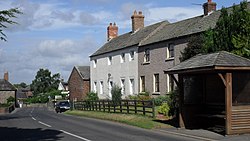
Burgh by Sands ( ) is a village and civil parish in the Cumberland unitary authority area of Cumbria, England, situated near the Solway Firth. The parish includes the village of Burgh by Sands along with Longburgh, Dykesfield, Boustead Hill, Moorhouse and Thurstonfield. It is notable as the site of the first recorded North African (Mauri) military unit in Roman Britain, garrisoning the frontier fort of Aballava on Hadrian's Wall in the 3rd century AD. It is also where Edward I of England died in 1307.
According to the 2011 census the parish had a population of 1,176. The village is about seven miles (11 km) west of Carlisle city centre. The village has a primary school, a pub and a post office. It also has a statue of Edward I at some distance to the north. Burgh was on the Carlisle Navigation canal from 1823 to 1853, after which it was served by the Port Carlisle railway, which was built on the bed of the canal, until its closure in 1932. From 1856 to 1964, railway trains operating on the Carlisle to Silloth line once again stopped at Burgh-by-Sands station.
278 m
North End, Cumbria
North End is the northernmost part of the village of Burgh by Sands in the Cumberland district of Cumbria, England.

455 m
Milecastle 72
Milecastle 72 (Fauld Farm) was one of a series of Milecastles or small fortlets built at intervals of approximately one Roman mile along Hadrian's Wall (grid reference NY32415913).