

 English
 Français
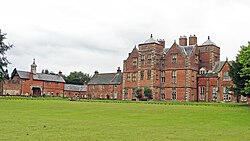
Kiplin Hall
Kiplin Hall is a Jacobean historic house at Kiplin in North Yorkshire, England, and a Grade I listed building. It is not far from the River Swale in the Vale of Mowbray. Kiplin Hall is a museum of history, a gallery and provides a biographical record of its past English country house owners. The nearest villages are Scorton, Great Langton and Bolton-on-Swale.
Nearby Places View Menu

563 m
Kiplin
Kiplin is a small hamlet and civil parish in the county of North Yorkshire, England. The population of the civil parish in 2015 was estimated by North Yorkshire County Council to be 60. As the population was less than 100, it was not separately counted in the 2011 census but included with the civil parish of Great Langton. Besides the hamlet of Kiplin, the civil parish includes Kiplin Hall, and is bisected by the B6271 road between Northallerton and Richmond, which cuts across the parish on a north-west to south-east axis.
Kiplin is too small to have a parish council, so has a parish meeting.
George Calvert, 1st Baron Baltimore and early coloniser of North America, was born there.

1.8 km
Killerby, North Yorkshire
Killerby is a civil parish in the county of North Yorkshire, England, 2 miles (3 km) south east of the village of Catterick. It consists of a few scattered houses and farms, with an estimated population in 2013 of only 10. There is no modern village in the parish.
Killerby was mentioned in the Domesday Book (as Chilvordebi), when it was a berewick to Catterick. In 1291 Bryan FitzAlan, lord of Bedale, was granted a licence to crenellate his house at Killerby. The foundations of the castle can still be traced. A hunting lodge was later built nearby, and its stable block built in 1788 survives. Killerby Hall, an impressive country house was built in 1906 on the site.
Killerby was a township in the ancient parish of Catterick in the North Riding of Yorkshire, and became a separate civil parish in 1866. From 1974 to 2023 it was part of the district of Hambleton, it is now administered by the unitary North Yorkshire Council.

1.9 km
St Mary's Church, Kirkby Fleetham
St Mary's Church is the parish church of Kirkby Fleetham, a village in North Yorkshire, in England.
The first church on the site was built in the Viking period. It was rebuilt in stone in the 12th century, from which period the south doorway survives. The nave and south chapel date from the 13th century, while the north aisle and west tower were added in the 15th century. The church was largely rebuilt in 1871, to a design by Henry Woodyer. The building was grade II* listed in 1966.
The church is built of stone and has roofs of lead and Welsh slate. It consists of a nave with a clerestory, a north aisle, a south porch, a south chapel, a chancel with a north vestry, and a west tower. The tower has three stages, diagonal buttresses, a south stair turret, bands, two-light bell openings, and an embattled parapet. There is also an embattled parapet along the nave. The south doorway is Norman and round-arched, with one order and zigzag decoration. Inside is a Norman font, which has been reworked, an effigy of Nicholas Stapleton, who died in 1290, and a monument to William Lawrence, carved in 1785 by John Flaxman.

1.9 km
Ellerton-on-Swale
Ellerton-on-Swale or Ellerton (historically known as Ellerton-upon-Swale) is a small village and civil parish about a mile east of Catterick in the county of North Yorkshire, England. In 2015, North Yorkshire County Council estimated the population of the parish at 110.
From 1974 to 2023 it was part of the district of Richmondshire, it is now administered by the unitary North Yorkshire Council.
The village sits just south of the B6271 road between Richmond and Northallerton, and has a large lake used for diving between the settlement and the River Swale to the south. Another lake to the west, Bolton-on-Swale Lake, is a former sand and gravel quarry and is now a Yorkshire Wildlife Trust sponsored nature reserve.
The name Ellerton derives from the Old Norse elri, or the Old English alor, meaning 'alder tree' and the Old English tūn meaning 'settlement'.
The village has an entry in the Domesday Book which states that it belonged to Count Alan and had six villagers. It is said that it is the birthplace of Henry Jenkins, who died in 1670 and is reported to have lived to an incredible age of 169 years. In 1743, a memorial obelisk was placed over his grave in the nearby churchyard of Bolton-on-Swale.