

 English
 Français

Kiplin
Kiplin is a small hamlet and civil parish in the county of North Yorkshire, England. The population of the civil parish in 2015 was estimated by North Yorkshire County Council to be 60. As the population was less than 100, it was not separately counted in the 2011 census but included with the civil parish of Great Langton. Besides the hamlet of Kiplin, the civil parish includes Kiplin Hall, and is bisected by the B6271 road between Northallerton and Richmond, which cuts across the parish on a north-west to south-east axis. Kiplin is too small to have a parish council, so has a parish meeting. George Calvert, 1st Baron Baltimore and early coloniser of North America, was born there.
Nearby Places View Menu
563 m
Kiplin Hall
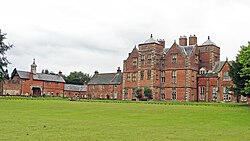
Kiplin Hall is a Jacobean historic house at Kiplin in North Yorkshire, England, and a Grade I listed building. It is not far from the River Swale in the Vale of Mowbray. Kiplin Hall is a museum of history, a gallery and provides a biographical record of its past English country house owners. The nearest villages are Scorton, Great Langton and Bolton-on-Swale.

1.4 km
St Mary's Church, Kirkby Fleetham
St Mary's Church is the parish church of Kirkby Fleetham, a village in North Yorkshire, in England.
The first church on the site was built in the Viking period. It was rebuilt in stone in the 12th century, from which period the south doorway survives. The nave and south chapel date from the 13th century, while the north aisle and west tower were added in the 15th century. The church was largely rebuilt in 1871, to a design by Henry Woodyer. The building was grade II* listed in 1966.
The church is built of stone and has roofs of lead and Welsh slate. It consists of a nave with a clerestory, a north aisle, a south porch, a south chapel, a chancel with a north vestry, and a west tower. The tower has three stages, diagonal buttresses, a south stair turret, bands, two-light bell openings, and an embattled parapet. There is also an embattled parapet along the nave. The south doorway is Norman and round-arched, with one order and zigzag decoration. Inside is a Norman font, which has been reworked, an effigy of Nicholas Stapleton, who died in 1290, and a monument to William Lawrence, carved in 1785 by John Flaxman.

1.4 km
Kirkby Fleetham Hall
Kirkby Fleetham Hall is a historic building in Kirkby Fleetham, a village in North Yorkshire, in England.
The manor of Kirkby Fleetham descended through the Stapleton family, then the Melthams, who sold it in 1600 to the Smelt family, with owners including Leonard Smelt. The property was bought in the 1720s by John Aislabie, MP for Ripon and Chancellor of the Exchequer, for his son William Aislabie, also MP for Ripon. The present house was built in the mid-1700s by William for his daughter, Ann Sophie, who had married William Lawrence. Subsequently, it was left by William's granddaughter, Sophia Elizabeth Lawrence, to her second-cousin once-removed, Harry Edmund Waller, thence to his son Edmund Waller VI, who sold it in 1889 to Edward Courage of the Courage brewing family. Since then much of the estate has been sold off. The hall has gone through several guises including hotel and "country retreat". It has been a family home since 2003 and in 2024 it was made available for a handful of exclusive weddings and events per year. It was grade II* listed in 1966.
The country house is built of rendered stone with stone dressings and hipped roofs of stone slate and lead. The main range has two storeys, a basement and attics, and seven bays, to the left is a link wall and a one-storey pavilion, and to the right is a single-storey three-bay wing. The main range has a sill band, the middle five bays have a cornice and a blocking course, and the outer bays project under pediments with moulded cornices. Steps lead up to a central doorway with an architrave, a Doric surround, a frieze and a cornice. In the ground floor of the outer bays are Venetian windows, and the other windows on the front are sashes, the window above the doorway tripartite. In the attic are five dormers with sashes. On the pavilion is a domed cupola with a bell. The north front has eleven bays, the outer three bays on each side projecting and bowed. Inside, the servants' staircase dates from about 1785, while the main staircase is 19th century. There are some early doorcases and cornices, and the dining room has a Neoclassical fireplace.

1.8 km
Great Langton
Great Langton is a small village and civil parish in North Yorkshire, England. The village lies on the B6271 road, between Scorton and Northallerton, on the northern bank of the River Swale and it was once known as Langton-upon-Swale.
From 1974 to 2023 it was part of the district of Hambleton, it is now administered by the unitary North Yorkshire Council.
The village church is St Wilfrid's Church, Great Langton; there used to be also the Chapel of the Good Shepherd, which has now been converted into a residential property. There was once a school in Great Langton but it also closed and is now a residential property. The village pub, which was known as The Langton Hotel until it changed its name to The Wishing Well in the 1970s, closed in 2004.
The village is a short distance from Kiplin Hall, the stately home built by George Calvert, 1st Baron Baltimore, the founder of Maryland.