

 English
 Français

Headingley Bear Pit
Headingley Bear Pit is a Grade II listed building (officially listed as The Old Bear Pit) in Headingley, Leeds, England. It was formerly part of Leeds Zoological and Botanical Gardens, which closed in 1858.
Nearby Places View Menu

13 m
Leeds Zoological and Botanical Gardens
Leeds Zoological and Botanical Gardens, also known as Headingley Zoo and later Leeds Royal Gardens, was open between 1840 and 1858 in Headingley, Leeds, West Yorkshire, approximately two miles out of the city centre and covering the area now occupied by Cardigan Road. It was established following an idea by Dr Disney Thorpe, designed by the Wakefield architect William Billinton, and built by public subscription during the 1830s.
The zoo was never particularly successful; only part of the envisioned landscape plan was built and it remained in debt for the whole of its existence. The Gardens closed for the first time in December 1848 but were auctioned and then operated for a further ten years before final closure. The site was redeveloped for the construction of Cardigan Road and large villas. There are very few traces of the zoo and gardens now, but remaining artefacts include the Bear Pit, much of the original stone perimeter wall along Chapel Lane, which are both Grade II listed, and many mature trees in what are now private residential gardens.

243 m
Our Lady of Lourdes Church, Leeds
Our Lady of Lourdes Church is a Roman Catholic church in the parish of St Jeanne Jugan, Leeds. It was built by the Society of Jesus in the 1920s and it is situated on Cardigan Road in Burley, Leeds.

315 m
Brudenell School
Brudenell School also known originally as Brudenell Council School was a mixed school for infants, juniors and seniors, on Welton Road in the Hyde Park area of Leeds, England. The large and impressive Victorian building dated from before 1900, and was demolished around 1990. A modern Primary School, built in 1992, now exists on the site.
358 m
The Golden Beam
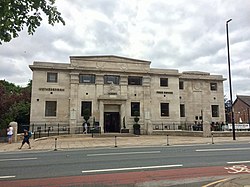
The Golden Beam is a pub and Grade II listed building located in the Headingley area of Leeds, West Yorkshire, England. It was built in c. 1912 for the Church of Christ, Scientist, and was known as the Elinor Lupton Centre from 1986 to 2010 when it was a school arts centre. It was designed by Piet de Jong and William Peel Schofield from the architectural firm Schofield and Berry. Constructed in white Portland stone in a mixed style of Egyptian Revival and Art Deco, it was originally built as a Sunday school in c. 1912–1914, extended in the 1930s with a church building and then used by the Leeds Girls' High School as a theatre and music centre from 1986 until 2010. The structure has architectural significance in the locality due to its distinct style and use of materials; many original features and fittings survive, including the entrance foyer, two staircases and a glazed lantern in the auditorium roof.
The building was unoccupied between 2010 and 2021, with windows and doors boarded up and elevations disfigured by graffiti. The building was included in the 2018 Heritage at Risk Register by Leeds Civic Trust, where it was given 'vulnerable' status. The current owner, JD Wetherspoon, put forward proposals for conversion into a pub and hotel which were locally controversial, with the project facing a planning enquiry and licensing difficulties. Planning permission and an alcohol licence were granted by the City Council in 2020, and the building was converted into a large pub, named The Golden Beam after a painting by Atkinson Grimshaw, which opened June 2021.